By using this site you agree to the use of cookies by the company in accordance with the Privacy Policy
Choosing the best Mcb Lock Off Kit in 2026 is not just a matter of picking the brightest color or lowest price. The right kit should fit the miniature circuit breaker securely, resist slipping, and make it clear that the circuit has been isolated. Small details matter. A loose clamp, awkward screw, or faded warning tag can complicate a routine job. Compatibility comes first.
This guide compares kits by breaker fit, locking method, materials, ease of use, and included tags or accessories. It also considers practical handling: can a technician install the device while wearing gloves, and does it stay firmly in place during a careful check? Not every kit suits every panel. Breaker shapes and dimensions vary, so confirm the manufacturer’s specifications before buying. Follow your workplace’s isolation procedure, and verify the circuit is de-energized with suitable test equipment. A lock-off device supports safe isolation; it does not replace those steps.
There is no universal winner. That may be less satisfying than a simple ranking, but it is more useful. A compact kit may suit a maintenance bag, while a broader set may serve teams working across different panels. The comparisons ahead highlight where each option performs well, where it falls short, and what to check before purchase. Even a well-made kit can be the wrong fit.
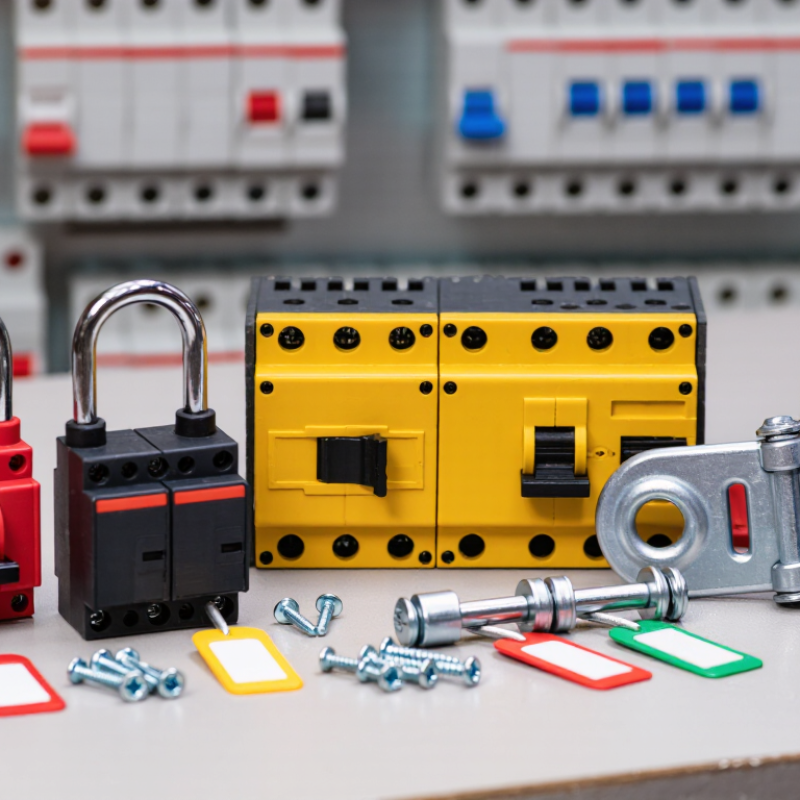
An MCB lock-off kit secures a miniature circuit breaker in its isolated position. It helps prevent someone from switching the circuit back on while maintenance is underway. A typical kit may include a breaker clamp, a padlock, and a warning tag. The clamp must fit the breaker type and hold firmly; a loose fit is not dependable. Small details matter.
Lockout/tagout starts with identifying the correct circuit and informing people who may be affected. A competent person switches off and isolates the supply, fits the lock-off device, then attaches a personal lock and a clear tag. The tag should identify the person responsible and explain why the circuit is isolated. Next comes verification: use a suitable, properly checked voltage tester to confirm the circuit is dead. A locked handle alone does not prove that electricity is absent.
Keep the key with the person who applied the lock, and remove the lock only through the site’s established procedure. Before work begins, consider other possible supplies, such as a separate feed or stored energy. Tags can smudge, and breaker labels can be wrong; verify the circuit rather than trusting the writing. A lock-off kit reduces risk, but it cannot replace training, careful checks, or clear communication.
A lock-off kit should fit the breaker’s toggle and body, not merely its current rating. IEC 60898-1 covers household and similar AC circuit-breakers rated up to 440 V, 125 A, and 25 kA short-circuit capacity. These limits describe the breakers covered by the standard; they do not define a universal toggle size. Two MCBs with the same rating can have different toggle widths, thicknesses, and clearances.
Check the manufacturer’s dimensional drawing, then measure the exposed toggle and space around it. A narrow clamp may slip on a broad toggle, while a bulky device can obstruct neighboring breakers. Test fit only under safe, isolated conditions, and confirm the lockout prevents the control from moving. That detail matters. IEC 60898-1 is the relevant product standard for many domestic MCBs; the actual fit still depends on the device geometry.
Tips: Compare the kit’s stated toggle range with measured width and thickness, in millimetres. Check clearance between adjacent poles and whether the breaker has a recessed or projecting toggle. Keep the model number and measurements together; field labels are not always precise. A little uncertainty remains when drawings omit dimensions, so verify the physical fit before relying on the kit.
Choosing the best MCB lock off kit in 2026 starts with fit, not the number of pieces. Check the breaker’s toggle width, shape, and available clearance against each device’s stated range. A lock that looks close may still slip, press against a neighboring breaker, or prevent the panel cover from closing. Test the fit only on equipment that has been safely isolated, and follow the panel and kit instructions. Small details matter.
Next, compare lock capacity and materials. Confirm how many padlocks the device accepts and whether its body accommodates the shackle sizes used at your site. Multiple lock points can support a controlled handover, but capacity alone does not guarantee a sound procedure. Look for durable, clearly labeled materials that resist cracking and remain legible after routine handling. Metal parts can feel sturdy, while suitable insulating components may also matter around electrical equipment. Check product specifications rather than judging by appearance. A little uncertainty is normal.
Tips: Measure the breaker before ordering, then compare the kit’s range with the actual toggle. Check hinge movement, cover clearance, and padlock fit. Keep the instructions with the kit. If the breaker type is unclear, pause and ask a qualified electrical professional; a guessed fit is not a reliable safeguard.
| Kit or device type | Typical fit | Lock capacity | Common materials | Main advantages | Limitations and checks | Best suited to |
|---|---|---|---|---|---|---|
| Universal clamp-on MCB lockout | Designed to clamp onto compatible breaker toggles; fit depends on toggle width, shape, and available clearance. | Commonly one padlock per device. A group lockout hasp can provide additional lock positions. | Often reinforced polymer, with metal clamping or adjustment components. | Can suit more than one breaker profile when the manufacturer’s compatibility range includes the breaker. | Check the breaker’s exact toggle dimensions and the device’s stated limits. Confirm the clamp stays secure and prevents operation. | Mixed panels where compatible toggle dimensions have been confirmed. |
| Pin-in MCB lockout | Fits only breakers with a suitable hole or pin feature in the toggle; pin size and position must match. | Usually one padlock per device; additional workers can be accommodated with a separate group-lockout hasp. | Commonly molded polymer, sometimes with metal pins or other metal components. | Provides a positive attachment on breakers designed to accept the pin connection. | Not a general-purpose fit. Check the breaker’s hole pattern, pin dimensions, and clearance before purchase. | Panels with known, compatible pin-style breaker toggles. |
| Tie-bar or linked-handle lockout | Intended for compatible breakers with linked or adjacent handles; configuration varies by breaker design. | Often one padlock on the lockout point. Use a hasp when multiple personal locks are required. | Typically polymer or metal, depending on the device design. | Can secure linked handles together where the lockout is specifically designed for that arrangement. | Verify the number and spacing of poles, handle linkage, and the device’s approved breaker range. Do not assume adjacent handles are mechanically linked. | Compatible multi-pole or linked-handle breaker arrangements. |
| Breaker-specific lockout device | Made for a defined breaker family or handle geometry rather than a broad range of MCBs. | Usually one padlock per device; check the product documentation for the shackle or lock-hole limits. | May use molded polymer, metal, or a combination of both. | Offers a more precise fit when the breaker model and lockout are confirmed as compatible. | Less adaptable if the panel contains different breaker types. Match the breaker identification and device instructions. | Sites with repeated, documented breaker models and a need for a consistent fit. |
| MCB lockout kit with hasps and accessories | Fit depends on the individual lockout devices included; a kit may contain more than one device style. | Varies by kit. The number of locks a group can accept is determined by the hasp or lockout device, not simply by the kit size. | May combine polymer lockouts with metal hasps and accessories. | Can support different isolation points and group lockout when its contents match the panel and procedure. | Check the contents list, compatible breaker types, number of lock positions, and any padlock shackle limits. | Teams needing a coordinated set of compatible devices and group-lockout accessories. |
Selection note: There is no single MCB lockout that fits every breaker. Confirm the breaker manufacturer’s compatibility information, toggle dimensions, pole arrangement, and the lockout device’s instructions before use. A lockout device prevents operation; it does not prove that a circuit is de-energized. Follow the applicable isolation procedure and verify absence of voltage with suitable test equipment.
OSHA estimates that effective lockout/tagout practices prevent about 120 deaths and 50,000 injuries each year. Those figures make a small breaker lockout more than a cabinet accessory. A technician opening a panel should be able to identify the correct circuit, isolate it, and keep the breaker from being switched on unexpectedly. Then comes verification: use an appropriate tester to confirm the circuit is de-energized before work begins. A lock alone does not prove that.
For a 2026 MCB lock off kit, “best” depends on the breaker design and the worksite routine. Check that the device fits the breaker toggle securely, accepts a personal lock, and stays attached when the enclosure door closes. A loose fit is not a minor annoyance. It can undermine the control. Clear labels and a simple way to record who applied the lock also help teams avoid confusion during shift changes.
Check compatibility on the actual panel, not just a product photograph. It takes a minute. Often less. Still, even a well-made kit cannot replace training, a written isolation procedure, or checking for stored energy. I have seen safety plans look complete on paper, while one unclear circuit label changes the whole job. That is worth thinking about.
Choosing the best MCB lock-off kit in 2026 starts with fit, not appearance. The device must match the breaker’s shape and operating handle, close securely, and accept a personal lock without forcing the switch. Check the panel label and the kit instructions before installation. Isolate the correct circuit, then fit the device as directed. Keep fingers clear of adjacent live parts. A lock-off kit does not prove that a circuit is dead.
Verify isolation with an adequately rated voltage tester, following your site’s safe-work procedure. Prove the tester on a known source before testing, check every relevant conductor, then prove it again. Watch for alternate feeds or stored energy; a single breaker may not control every source. OSHA estimates that effective lockout/tagout prevents about 120 fatalities and 50,000 injuries each year. That figure covers hazardous-energy controls broadly, not MCB kits alone. The distinction matters. A checklist can feel repetitive, but skipping verification is a poor shortcut.
Before each use, inspect the kit for cracks, worn threads, corrosion, or a loose clamp. Confirm the lock engages and the breaker cannot be switched on. Remove damaged equipment from service, and record inspections under your workplace procedure. Keep the kit clean and dry, with its key controlled by the person applying the lock. OSHA’s estimate is a useful reminder, not a substitute for training or local rules. Even a well-fitted device can be misapplied.
By using this site you agree to the use of cookies by the company in accordance with the Privacy Policy
Have a questions or want to know more about our company? We'll be expecting you.