By using this site you agree to the use of cookies by the company in accordance with the Privacy Policy
China has become a significant production base for advanced transfer materials. Among them, White 3D UV TPU DTF Film serves demanding applications in apparel, accessories, packaging, and customized products. Its performance depends on more than a bright white surface. Film thickness, TPU flexibility, adhesive response, ink reception, and curing stability must work together.
Polymer materials expert Dr. George W. Ehrenstein emphasized, “The properties of plastics are determined by their structure and processing.” This principle remains highly relevant to White 3D UV TPU DTF Film. A reliable manufacturer should control resin selection, coating uniformity, surface energy, and release behavior. Production teams should also test film curling, edge lifting, color density, and adhesion after transfer. Small variations can become visible under strong showroom lighting.
Good manufacturing is measurable. Samples should be checked through repeated printing and application trials, not only visual inspection. A stable film should feed smoothly, preserve raised details, and remain flexible after pressing. It should also perform consistently across different printers and ink systems. That expectation is difficult, but necessary.
There is room for improvement. No film performs perfectly on every fabric, temperature setting, or production line. Humidity can change handling results. Operator technique can also influence the final appearance. For this reason, a professional China supplier must provide technical data, batch traceability, application guidance, and responsive testing support. The strongest manufacturer is not merely the one offering a competitive price. It is the partner that explains limitations honestly and improves the product through verified experience.
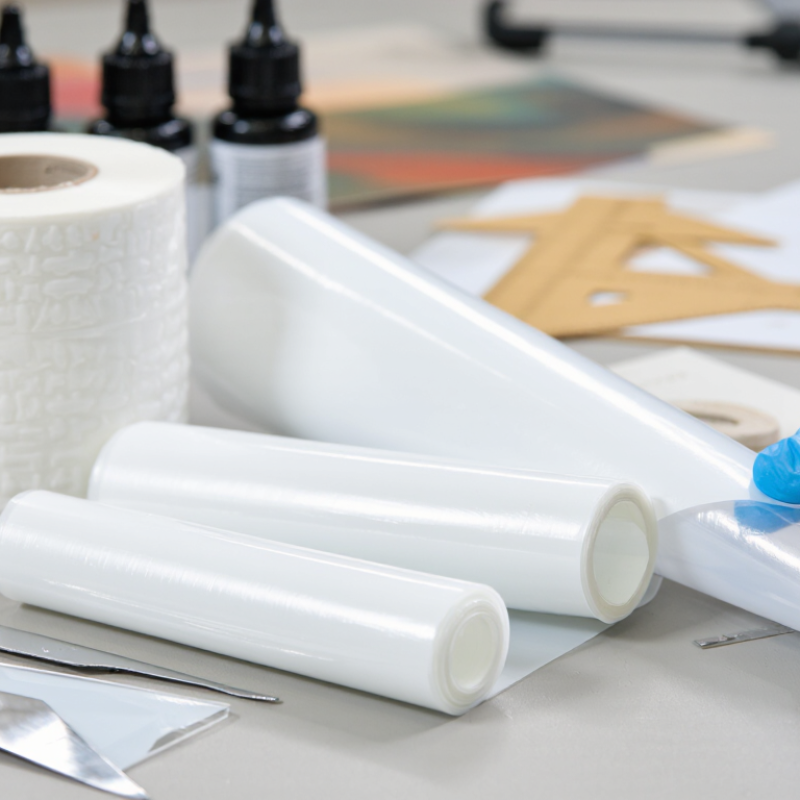
White 3D UV TPU DTF film is a printable transfer material for creating raised, bright graphics on selected surfaces. It usually combines a white TPU-based layer with a UV-printable coating. The white layer improves color visibility on dark or transparent items. The 3D effect comes from controlled ink buildup, surface texture, or both.
In practical production, operators print artwork onto the film, apply suitable color layers, and transfer the design after proper curing. White ink often works as a foundation. It helps red, blue, and fine details appear stronger. The TPU layer provides flexibility, which can reduce cracking on curved or lightly flexible products. However, performance depends on film thickness, coating quality, ink compatibility, curing energy, and storage conditions.
An experienced supplier should test adhesion, stretch resistance, edge clarity, and surface feel before regular production. I have found that a dramatic raised effect is not always the most durable choice. Excessive ink height may create uneven edges or weak bonding. Temperature and pressure settings also need adjustment for each substrate. Some results look excellent immediately, yet fail after rubbing or humidity exposure. That is why reliable manufacturers document batch data and provide application guidance. White 3D UV TPU DTF film can support detailed decoration, but careful testing remains necessary for consistent commercial use.
China Top White 3D UV TPU DTF Film Manufacturer
Key Materials and Structural Features
White 3D UV TPU DTF film depends on a balanced multilayer structure. The carrier film provides dimensional stability during printing and transfer. A release coating controls separation without tearing delicate details. The TPU layer adds softness, stretch, and improved adhesion on uneven surfaces. A white ink-receptive layer increases opacity, especially on dark bags, panels, and promotional items. According to Grand View Research, the digital textile printing market was estimated at USD 2.72 billion in 2023. It is projected to grow at a 19.1% CAGR through 2030. This growth increases demand for reliable, flexible transfer materials.
In production testing, film thickness often changes the result. A thin structure follows curved surfaces better, but it may wrinkle during feeding. A thicker TPU layer feels stronger, yet excessive thickness can reduce fine-edge definition. Surface energy, curing temperature, and ink adhesion must work together. The wrong combination creates silvering, weak bonding, or visible white halos. I have found that “3D” performance is not only a material feature. It also depends on pressure, curing control, and the receiving surface. That detail is often overlooked.
Tips: Check release performance after complete curing, not immediately. Measure white-layer opacity with a black test panel. Store film flat, sealed, and away from humidity. Small batches should be tested first. Some results remain inconsistent, so production records deserve regular review.
| Component or Dimension | Typical Material or Specification | Key Structural Features and Functional Role | Common Reference Data |
|---|---|---|---|
| Base Film | Transparent PET carrier film | Provides dimensional stability during printing, curing, cutting, and transfer. PET offers good flatness, tensile strength, and heat resistance compared with many flexible plastic films. | Typical thickness: 50–100 μm |
| Release Layer | Silicone-based or other controlled-release coating | Controls separation between the carrier film and the printed transfer. A balanced release force helps prevent premature lifting while allowing clean application to the target surface. | Release performance depends on coating formulation and storage conditions |
| Surface Treatment | Corona-treated or coated printable surface | Improves surface energy and ink wetting, helping UV-curable ink form a more uniform image layer and reducing defects such as pinholes or uneven coverage. | Surface energy is commonly controlled above untreated PET levels |
| White Ink Layer | UV-curable white ink containing titanium dioxide pigment | Creates opacity, supports color brightness on dark or transparent substrates, and forms part of the raised 3D visual effect when multiple ink layers are applied. | White ink is normally printed beneath CMYK or color layers |
| Color Ink Layer | UV-curable CMYK or expanded-gamut ink set | Produces the visible image. UV curing polymerizes the ink rapidly under ultraviolet light, allowing the printed pattern to remain on the film during handling and transfer. | Typical curing wavelengths: approximately 365–405 nm |
| 3D Raised Layer | Additional UV ink or clear varnish buildup | Builds tactile relief and visual gloss. The final height depends on the number of passes, ink volume, artwork design, and curing conditions. | Common relief height: approximately 50–300 μm |
| Adhesive Layer | Heat-activated TPU adhesive powder or TPU adhesive coating | Forms the bonding interface between the printed transfer and the substrate. TPU is valued for flexibility, abrasion resistance, and compatibility with many textile and coated surfaces. | Typical powder particle size: approximately 80–200 μm |
| Adhesive Activation | Heat and pressure activation | Heating softens the TPU adhesive so it can wet the receiving surface; pressure improves contact and helps reduce voids at the interface. | Typical activation range: approximately 120–160 °C, depending on adhesive grade |
| Film Width | Roll-fed PET film format | Width should match the printer, laminator, or cutting equipment. Stable winding and uniform thickness help reduce tracking problems during continuous processing. | Common commercial widths: 300, 330, 600, and 630 mm |
| Film Length | Roll packaging | Long rolls support continuous production and reduce the number of media changes. Actual roll length is selected according to equipment capacity and handling requirements. | Common roll lengths: 50–100 m |
| Overall Thickness | PET carrier plus release, ink, and adhesive layers | A controlled total thickness supports feeding stability while maintaining flexibility after transfer. Excessive thickness may reduce conformability on curved or textured surfaces. | Often approximately 100–250 μm, depending on the construction |
| Surface Finish | Gloss, matte, or selective clear-gloss finish | The finish influences light reflection, tactile perception, color appearance, and the visibility of raised details. | Gloss finishes provide higher reflectivity; matte finishes reduce surface glare |
| Compatible Substrates | Polyester, cotton blends, coated plastics, leather-like materials, and selected rigid surfaces | Compatibility depends on surface cleanliness, coating chemistry, heat resistance, and the bonding behavior of the TPU adhesive. | Always verify adhesion and wash or abrasion performance on the intended substrate |
| Flexibility | Elastic TPU adhesive and flexible cured ink construction | Supports bending and moderate stretching without immediately cracking when the transfer is properly cured and applied. | Performance varies with ink thickness, substrate elongation, and curing conditions |
| Storage Conditions | Dry, sealed, dust-free environment | Moisture, heat, dust, and direct sunlight can affect release properties, adhesive flow, print quality, and roll flatness. | Common recommendation: 15–30 °C and relative humidity below 70% |
| Quality Control Items | Thickness, width, release force, adhesion, curing, and visual uniformity | Routine inspection helps identify coating streaks, pinholes, color variation, poor powder coverage, edge curl, and transfer failure. | Tests should be conducted with the actual printer, ink, adhesive, substrate, and process settings |
The specifications shown are typical industry reference ranges rather than company-specific claims. Actual values may vary according to the film construction, ink system, adhesive grade, printing equipment, and application process.
A reliable UV TPU DTF printing process starts with a clean digital file. The operator prints color layers onto the coated film. White ink follows when stronger opacity is required. A clear varnish layer can add gloss, texture, or protection. UV lamps cure each layer immediately, leaving a firm image on the film.
The printed film is then laminated with an adhesive TPU transfer film. Pressure matters here. Uneven pressure can trap small air pockets or weaken the transfer. After trimming, the operator removes the backing and presses the design onto glass, coated metal, acrylic, leather, or other smooth surfaces. No heat press is normally required. A slow peel helps preserve fine lettering and narrow edges.
A 2024 Mordor Intelligence market report projects the UV-curable inks market to grow at about 8% annually through 2030. This growth reflects demand for fast curing and durable decoration. However, market growth does not remove process risks. Humidity, dust, film storage, and curing energy still affect results. The weak point is often preparation, not equipment.
Tips: Keep film sealed and flat. Test adhesion on the final substrate. Check white density before production. Use a small sample first. Some failures remain difficult to explain, so record temperature, pressure, and curing settings for every batch.
China Top White 3D UV TPU DTF Film Manufacturer
Quality Standards for Selecting a Reliable Manufacturer
Selecting a reliable white 3D UV TPU DTF film manufacturer requires more than checking price. The film should produce dense white coverage without hiding fine artwork. Inspect printed samples under natural light and strong indoor lighting. Raised areas must feel even, not brittle or excessively rubbery. A dependable manufacturer should provide thickness data, adhesive information, curing guidance, and batch records. These details show process control and technical experience.
Tips: Request samples from different production batches. Test them on glass, coated metal, plastic, and textured surfaces. Check color strength, edge definition, adhesion, flexibility, and resistance after cleaning. Ask how the supplier controls dust, moisture, and temperature during production. A clean factory matters because tiny particles can create pinholes in white layers. Production records and inspection reports are useful, but hands-on testing remains essential.
A reliable supplier should explain limitations honestly. Some films may perform well on smooth surfaces but struggle with curved objects. Humidity can also affect transfer results. Do not accept vague claims about universal compatibility. Confirm packaging quality, storage conditions, lead times, and replacement procedures before ordering. Communication speed is not everything. Technical answers matter more. In practice, even a qualified manufacturer may show slight variation between lots, so incoming inspection should remain part of your workflow. A small test can prevent a large production problem.
White 3D UV TPU DTF film supports detailed, raised transfers on many hard surfaces. It suits phone cases, coated wood, acrylic panels, metal signs, gift boxes, and decorative packaging. The white base improves color brightness on dark or transparent substrates. Its flexible TPU layer can also help preserve fine edges during application.
In practical production, operators should test adhesion on each surface before full release. Surface coatings, dust, and uneven pressure can change the final result. The film can create tactile lettering and layered artwork without traditional screen preparation. However, “3D” does not guarantee unlimited durability. Strong abrasion, outdoor exposure, or unsuitable cleaning agents may reduce performance. Experienced users check transfer temperature, pressure, and curing conditions through small test runs.
Tips: Store rolls flat or upright in their original packaging. Keep them away from direct sunlight, moisture, and heat sources. A stable room temperature is preferable, with moderate humidity. Avoid placing heavy cartons on the film, as pressure may cause wrinkles or blocking. Let cold material reach room temperature before use. This step is easy to overlook. Inspect the surface for dust and edge damage before printing. Record storage time and test results for consistent production. Some workshops skip this record, then struggle to identify the real cause of defects.
By using this site you agree to the use of cookies by the company in accordance with the Privacy Policy
Have a questions or want to know more about our company? We'll be expecting you.