China Top 10 3 Phase Brushless DC Motor Manufacturers
China has become a major production center for efficient electric motor systems. Its factories serve automation, electric vehicles, medical equipment, pumps, fans, and warehouse robots. This article examines China’s top 10 3 Phase Brushless Dc Motor manufacturers through a practical industry lens.
The International Energy Agency reports that electric motor systems consume nearly half of global electricity. Efficiency improvements can therefore produce measurable savings in factories, buildings, and transport equipment. Grand View Research also identifies rising automation, electrification, and demand for compact motors as key market drivers. These trends increase interest in the 3 Phase Brushless Dc Motor, especially where low maintenance, precise speed control, and high power density matter.
The selected manufacturers are assessed through product range, winding quality, controller compatibility, certifications, production capacity, testing procedures, and export experience. Useful evidence includes datasheets, factory audits, sample testing, warranty terms, and customer feedback. Real details matter. A stable motor should start smoothly, hold speed under load, and avoid excessive heat after continuous operation.
Ranking suppliers is not perfectly scientific. Public revenue data remains incomplete, and market reports use different definitions. Some manufacturers publish impressive specifications without showing independent test results. That weakness deserves attention. The following list combines available industry research with practical purchasing considerations, rather than treating promotional claims as proof. Readers should still verify voltage, torque, insulation class, ingress protection, noise, and delivery capability before selecting a long-term supplier.
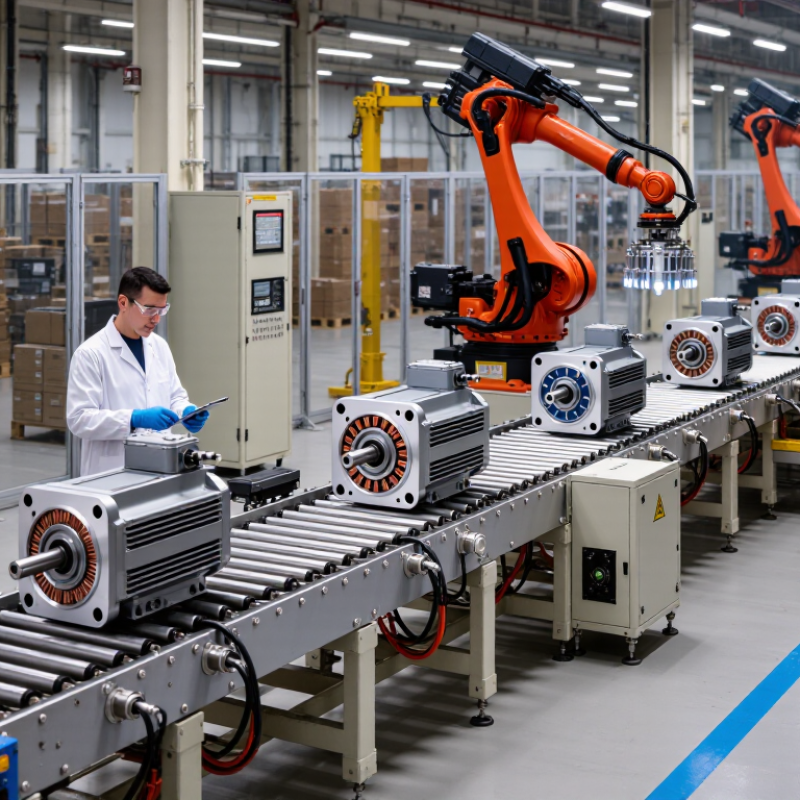
Definition and Role of Three-Phase Brushless DC Motors
A three-phase brushless DC motor uses electronic switching instead of mechanical brushes. Its stator contains three winding groups, while permanent magnets sit on the rotor. A controller energizes these phases in sequence, creating a rotating magnetic field. The rotor follows this field and produces continuous mechanical motion.
This design delivers strong starting torque, accurate speed control, and lower maintenance. It is widely used in pumps, cooling fans, robotics, electric tools, and automated production equipment. In China’s motor manufacturing sector, engineers often adjust winding layouts, magnets, and sensor settings for different loads. A factory conveyor may need steady torque at low speed, while a compact fan needs quiet operation and efficient airflow. Hall sensors can improve positioning, but sensorless control may reduce wiring and cost. The choice depends on operating conditions.
Heat remains a practical concern. A motor can appear efficient during a short test, then lose performance inside a sealed machine. Engineers should check temperature rise, vibration, current stability, and controller compatibility under real loads. In practice, no design is perfect. Bearing wear, electrical noise, and poor cooling can still shorten service life. Careful testing matters more than attractive rated figures. When evaluating a manufacturer, buyers should request measured efficiency curves, protection ratings, balancing records, and sample test data. That evidence supports safer selection and more reliable long-term operation.
China Top 10 3-Phase Brushless DC Motor Manufacturers: Definition and Role of Three-Phase Brushless DC Motors
Three-phase brushless DC motors use electronic commutation instead of mechanical brushes. Their controller energizes two phases at a time, while the third phase remains unenergized, producing a rotating magnetic field and continuous torque.
How to read the chart: The six-step sequence represents one electrical cycle. A value of +1 indicates positive phase energization, -1 indicates negative phase energization, and 0 indicates that the phase is floating. This commutation method supports efficient electronic torque production in three-phase BLDC motor systems.
China’s Top 10 Three-Phase BLDC Motor Manufacturers
China’s Top 10 Three-Phase BLDC Motor Manufacturers are shaping demand for efficient motion systems. Their products serve robots, electric tools, cooling equipment, conveyors, and compact industrial machines. The strongest manufacturers usually combine winding expertise, rotor balancing, controller matching, and stable quality control.
During supplier evaluations, engineers should inspect more than catalog power ratings. A reliable factory can explain torque curves, insulation classes, bearing choices, and thermal limits clearly. It should also provide load-test records, vibration data, and samples from regular production lines. Look for precise machining, clean assembly areas, and traceable inspection procedures. Small details matter. A loose connector can stop an otherwise excellent motor.
The leading ten companies generally differ in their specializations. Some focus on high-speed motors for fans and pumps. Others develop low-noise drives for household equipment or high-torque units for automation. Strong manufacturers support custom shafts, mounting holes, sensor layouts, and communication interfaces. They also understand regional certification requirements and export documentation.
Cost remains important, but the lowest quotation may hide weaker magnets, inconsistent bearings, or limited testing. A ranking can still be imperfect. Factory capacity changes, and sample performance may not represent every batch. Buyers should repeat testing under real voltage, temperature, and duty cycles. Ask difficult questions. Reliable suppliers welcome them.
Product Capabilities, Industries, and Application Areas
China Top 10 3 Phase Brushless DC Motor Manufacturers
China’s leading three-phase brushless DC motor manufacturers serve automation, robotics, medical equipment, pumps, and electric mobility. Their product capabilities often include high-efficiency motors, integrated Hall sensors, encoder feedback, and customized winding designs. Common voltage ranges support 24V, 48V, and higher industrial systems. Engineers should check continuous torque, peak torque, speed range, thermal limits, and controller compatibility. A motor may look powerful on paper, yet lose performance inside a poorly ventilated enclosure. Factory experience matters here. Reliable manufacturers usually provide test curves, insulation data, vibration results, and sample validation before volume production.
Application areas differ by operating conditions. Conveyor systems need stable torque and frequent starts. Robotic joints demand low backlash, compact dimensions, and precise feedback. Pumps require corrosion-resistant housings and long bearing life. Medical devices need quiet operation and careful quality control. Electric mobility platforms often prioritize power density, cooling, and regenerative braking compatibility. Certification documents should match the target market, not merely show general compliance. Some specifications remain unclear. Buyers should request measured data under real loads rather than relying on catalog values.
Tips: Compare at least three suppliers using the same technical checklist. Ask for winding resistance, efficiency at several speeds, noise readings, and thermal test duration. Confirm whether testing covers the complete motor-controller system. Inspect sample consistency across batches. Do not select only by unit price. A cheaper motor can create higher service costs. Also, allow time for custom tooling; rushed development often hides small but costly design compromises.


