Top Exercise Bench Suppliers for Global Buyers?
Selecting the right Exercise Bench supplier can influence product safety, customer satisfaction, and long-term business growth. Global buyers need more than attractive prices and polished catalogs. They need dependable manufacturing evidence.
A credible supplier should demonstrate consistent material quality, accurate load ratings, and careful production control. Inspect the frame welds, adjustment pins, foot pads, and upholstery edges. These details reveal how a bench may perform after months of repeated use. Small details matter. Ask for factory photographs, test reports, sample evaluations, and clear warranty terms. Where relevant, review quality systems such as ISO 9001 and applicable regional fitness-equipment requirements. However, certifications should support verification, not replace it.
Top suppliers usually communicate quickly and explain limitations honestly. They clarify steel thickness, foam density, maximum user weight, packaging dimensions, lead times, and spare-part availability. Experienced buyers should also compare container efficiency, because a bulky package can reduce the value of a low unit price. Independent inspections may expose issues that samples do not show. That step costs money, but it can prevent larger losses.
No supplier fits every market. A commercial gym may require heavier frames and longer warranties, while a home-fitness distributor may prioritize compact packaging and flexible customization. Some published specifications may remain incomplete. That deserves reflection. This guide compares leading Exercise Bench suppliers through product quality, manufacturing capability, export experience, communication, and buyer feedback. The goal is not to declare one universal winner. It is to help global buyers make a measured, evidence-based decision.
Exercise Bench Types and ISO 20957 Safety Requirements
Top Exercise Bench Suppliers for Global Buyers?
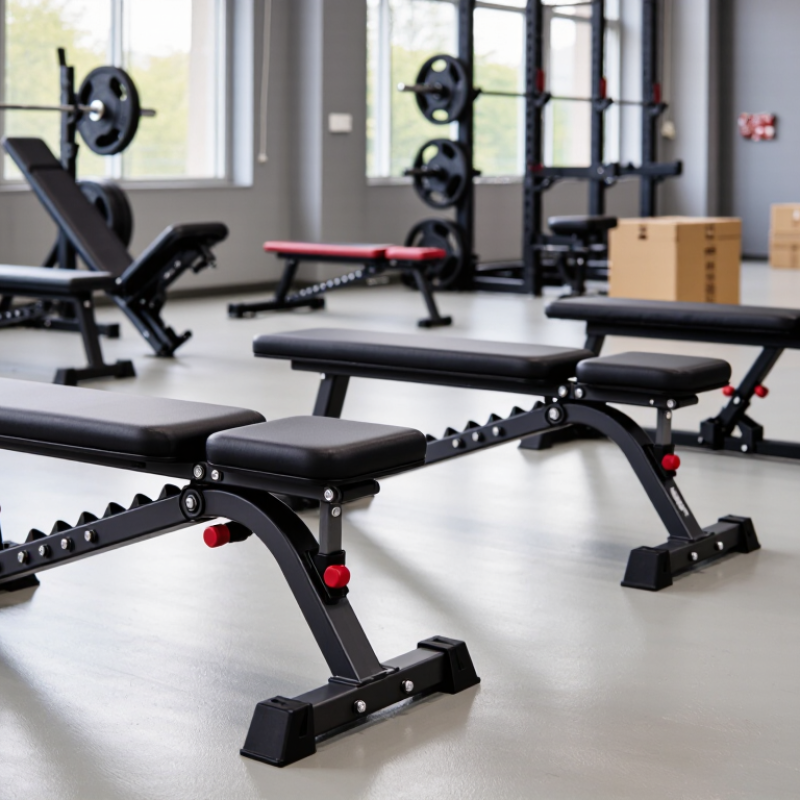
Exercise bench selection starts with use, not appearance. Flat benches suit basic pressing and dumbbell work. Adjustable benches support incline, shoulder, and seated exercises. Olympic benches add wider racks and higher loading potential. Compact utility benches help smaller studios, but their stability can be limited.
ISO 20957-1 sets general safety principles for stationary training equipment. ISO 20957-2 addresses strength training equipment, including relevant bench applications. Buyers should request test reports, rated user loads, assembly instructions, warning labels, and maintenance procedures. A supplier’s “commercial grade” claim is not proof of compliance. Check weld quality, frame deflection, locking pins, pad gaps, sharp edges, and anti-slip feet. The bench should remain stable when a user reracks a loaded bar.
The Health & Fitness Association’s 2024 Global Report estimated 184 million fitness facility members worldwide in 2023. That scale increases demand for durable, repeat-use equipment. ACSM’s 2024 Worldwide Survey of Fitness Trends ranked traditional strength training fifth globally, showing continued market relevance. Still, reports describe trends, not product safety. A careful buyer should compare ISO evidence with realistic site conditions, including humidity, cleaning chemicals, floor unevenness, and frequent adjustments. Small details matter. A loose hinge can become a serious failure point. My own procurement view is cautious: even strong documentation cannot predict every misuse, and supplier audits should include physical sample testing before larger orders.
Global Supplier Rankings Based on UN Comtrade HS 9506 Trade Data
Top Exercise Bench Suppliers for Global Buyers?
Global supplier rankings under HS 9506 should begin with UN Comtrade data, not promotional claims. This customs category covers sports and exercise equipment, but it does not isolate exercise benches perfectly. A leading exporter may therefore ship benches alongside other products. That limitation matters.
A practical ranking can compare export value, shipment volume, annual growth, and destination coverage. High export value suggests market strength. It does not guarantee better construction. Buyers should also review unit values, repeated trade activity, and dependence on one major market. A supplier base with several destinations may offer more stable purchasing options. Trade records are useful evidence.
Factory checks still matter. Inspect weld seams, frame alignment, bolt quality, and adjustment points. Test the bench under repeated loading, not only a single maximum load. Check foam recovery after compression. Packaging deserves attention too. Sharp metal edges can damage cartons during long-distance transport.
HS 9506 data can narrow the search. It cannot replace technical verification. My own procurement view is less certain when shipment descriptions are broad or incomplete. Some rankings may reflect trading companies rather than factories. That distinction should be stated clearly. Buyers should request recent test reports, production photos, sample inspections, and consistent export documentation before placing larger orders. Price alone is a weak ranking tool.
Commercial Bench Specifications: 150–300 kg Loads and 30–50 mm Pads
When comparing top exercise bench suppliers for global buyers, load documentation deserves close attention. A commercial bench rated for 150–300 kg must define that figure clearly. It may include the user, barbell, and stored equipment. Some suppliers list only a maximum static load, which can mislead purchasing teams.
I look for tested working loads, not impressive numbers alone. The frame should use stable steel sections, reinforced joints, and controlled weld quality. Adjustable backrests need secure locking points with little side movement. A practical inspection includes repeated loading, angle changes, and floor stability checks. Small movements become serious concerns in busy training rooms.
Pad thickness also affects long-term use. A 30–50 mm pad can balance comfort, support, and bench stability. Thicker foam is not automatically better. Dense foam should resist early compression, while the cover needs sealed seams and easy cleaning. Suppliers should provide material details, test dates, warranty terms, and replacement-part access. Ask whether ratings were tested under realistic movement. That detail is often missing.
In my experience, a bench may feel solid during a short demonstration yet loosen after repeated adjustments. That weakness is easy to overlook. Global buyers should compare drawings, certificates, packaging protection, and assembly instructions before ordering. A reliable supplier answers technical questions directly and records specification changes in writing.
Global Buyer Scorecards for Quality, Compliance, Cost, and After-Sales Support
Global buyers need more than a supplier list when comparing exercise bench manufacturers. A practical scorecard should measure quality, compliance, cost, and after-sales support together. In sourcing reviews, small details often reveal production discipline. Inspect weld seams, frame alignment, padding recovery, and adjustment pin fit. Ask for load-test records from recent production batches. A polished sample can hide inconsistent factory output.
Compliance deserves its own section. Request material specifications, user instructions, warning labels, and traceable inspection records. Confirm that documents match the destination market and the exact bench model. Vague certificates create delays. They may also increase customs and testing costs. Factory audits, video inspections, and independent pre-shipment checks provide stronger evidence than promises alone. Still, no audit captures every future batch.
Cost comparisons should include packaging, replacement parts, freight damage, warranty labor, and payment terms. A cheaper bench may require stronger cartons or more frequent repairs. Score response time, spare-part availability, repair guidance, and escalation procedures. Ask how quickly the supplier can replace a damaged adjustment knob or torn pad. Test communication before placing a large order. One unanswered technical question can be revealing. My own scorecards have missed regional service limitations before, so I now verify local repair coverage in writing. A balanced rating system usually works better than selecting the lowest quotation.
Top Exercise Bench Suppliers for Global Buyers? - Global Buyer Scorecards for Quality, Compliance, Cost, and After-Sales Support
Anonymized supplier benchmark for commercial and institutional exercise bench procurement
| Supplier Profile | Primary Supply Region | Quality Score
(30%) | Compliance Score
(25%) | Cost Competitiveness
(20%) | After-Sales Support
(15%) | Delivery Reliability
(10%) | Weighted Total
(100) | Typical MOQ | Indicative Lead Time | Buyer Status |
| Supplier Profile 01 | East Asia | 92 | 90 | 84 | 91 | 86 | 89.0 | 50–100 units | 35–50 days | Preferred |
| Supplier Profile 02 | Southeast Asia | 87 | 85 | 90 | 82 | 84 | 85.9 | 100–200 units | 40–60 days | Qualified |
| Supplier Profile 03 | Europe | 94 | 95 | 72 | 93 | 88 | 88.6 | 20–50 units | 30–45 days | Preferred |
| Supplier Profile 04 | South Asia | 82 | 80 | 93 | 76 | 78 | 82.4 | 100–300 units | 50–70 days | Qualified |
| Supplier Profile 05 | North America | 93 | 92 | 65 | 94 | 92 | 86.8 | 10–30 units | 20–35 days | Preferred |
| Supplier Profile 06 | Eastern Europe | 86 | 88 | 74 | 83 | 85 | 83.3 | 30–80 units | 35–55 days | Qualified |


