By using this site you agree to the use of cookies by the company in accordance with the Privacy Policy
An IR Corrected Lens must do more than produce a sharp image in visible light. It needs to maintain focus across visible and near-infrared wavelengths, where many ordinary lenses shift the focal plane. That difference matters in day-and-night security cameras, machine-vision stations, and outdoor monitoring systems. A small focus error can soften fine details, especially near the image edges.
Warren J. Smith, author of Modern Optical Engineering, is a respected reference in lens design. A useful paraphrase of his engineering approach—not a verified verbatim quotation—is: “Judge an optical system by the image it delivers.” Focus matters. For global buyers, that means looking beyond a product label. Compare wavelength range, sensor compatibility, distortion, coating details, and performance across the frame. Ask suppliers for test data and sample images captured under both visible and near-infrared illumination. Check how they document tolerances, production consistency, and technical support. Those details can reveal more than a polished catalog page.
This guide examines ten IR Corrected Lens manufacturers through practical buyer criteria, including product range, customization, quality controls, and export readiness. The comparison is a starting point, not a substitute for application testing. Lens performance depends on the sensor, aperture, working distance, and lighting. Some specifications also need clearer verification than manufacturers’ summaries provide. A careful shortlist—and a real sample test—can prevent costly surprises.
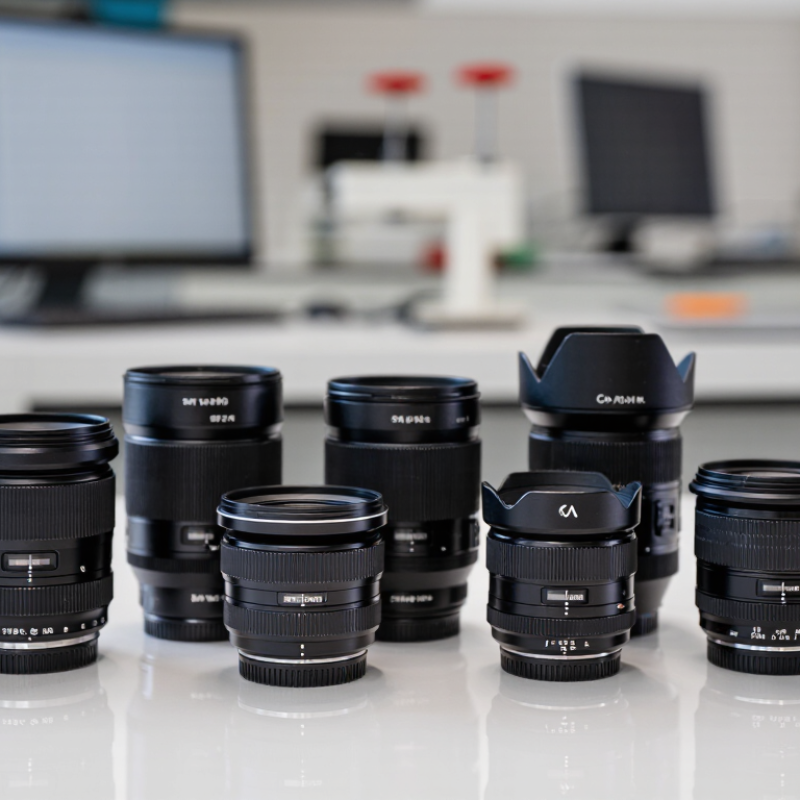
An IR-corrected lens is designed to keep images acceptably sharp across specified infrared wavelengths, where ordinary glass lenses may shift focus. The cause is dispersion: a material bends different wavelengths by different amounts. Optical designers combine elements with differing dispersion and select substrates that transmit the intended band. The result is reduced chromatic focus error, not a promise of perfect focus at every wavelength. That distinction matters.
ISO 20473:2007 classifies near-infrared as 0.78–3 micrometers and mid-infrared as 3–50 micrometers. These broad ranges are not interchangeable: a lens for near-infrared inspection may not transmit thermal-imaging wavelengths. Buyers should check the specified spectral range, transmission curve, sensor size, and working distance. Check the curve. A practical test is to focus on a high-contrast target, then compare sharpness at the band’s short and long ends. The “IR-corrected” label is not always specific enough; product documents should state the correction range and test conditions. Even then, performance can vary with aperture and temperature, so laboratory figures may not match a moving production line.
A practical, brand-neutral checklist for comparing manufacturers of infrared-corrected lenses. The entries below are evaluation criteria, not a ranked list of companies.
What IR correction means: An IR-corrected lens is designed to maintain usable focus across specified visible and infrared wavelengths, reducing the focus shift that can occur because optical materials refract different wavelengths differently. “IR corrected” does not mean every lens covers every infrared band; confirm the actual wavelength range and test conditions for each lens.
| Buyer evaluation area | What to verify with the manufacturer | Why it matters |
|---|---|---|
| 1. Supported wavelength range | Request the specified operating band, such as visible-to-near-infrared coverage, and check whether performance is stated for the full range or only selected wavelengths. | “IR corrected” is not a single universal wavelength specification. The lens must suit the sensor and illumination wavelengths used in the application. |
| 2. Focus shift across wavelengths | Ask for focus-shift data or test results at the relevant visible and IR wavelengths, including the measurement method and focus reference. | Different wavelengths can come to focus at different image-plane positions. Correction is intended to reduce that difference over the specified band. |
| 3. Optical format and image circle | Confirm that the lens image circle covers the sensor format, and check the specified image circle against the sensor’s active area. | An image circle that is too small can cause corner shading or vignetting, even when the lens’s focal length and mount are suitable. |
| 4. Resolution and sensor compatibility | Review the lens’s resolution or MTF data at the intended wavelengths, image height, aperture, and working distance. Confirm compatibility with the sensor pixel size if available. | Resolution depends on the lens, wavelength, aperture, and sensor together; a single headline figure may not describe edge performance or IR performance. |
| 5. Aperture and low-light performance | Compare the maximum aperture and the aperture range over which the manufacturer provides performance data. | A larger aperture can admit more light, while stopping down often changes depth of field and aberration performance. The best setting depends on the application. |
| 6. Transmission and coatings | Request transmission information for the intended wavelength band and confirm that coating specifications apply to the lens configuration being quoted. | Optical transmission varies with wavelength and optical surfaces. Visible-band coating claims alone do not establish performance in the near-infrared. |
| 7. Distortion and field coverage | Check distortion data and inspect image-quality information across the center and corners of the image circle. | Distortion can affect measurement and image alignment, while edge performance is important when the full sensor area is used. |
| 8. Mount and mechanical fit | Confirm mount type, flange focal distance, back-focus requirements, filter or accessory clearance, and mechanical dimensions. | Mechanical compatibility helps ensure the lens can be installed and focused correctly in the camera system. |
| 9. Environmental and operating conditions | Ask for the specified operating temperature, storage conditions, and any stated vibration, shock, sealing, or environmental ratings. | Performance and reliability requirements differ between controlled indoor systems and equipment used in industrial or outdoor environments. |
| 10. Documentation and sample validation | Request a current datasheet, wavelength-specific test information, dimensional drawings, and—where practical—a sample for evaluation in the intended camera setup. | Testing the actual lens, sensor, filter, and illumination combination is a reliable way to check focus, coverage, and image quality before production purchasing. |
IR-corrected lenses are useful when a camera must stay in focus across visible and near-infrared wavelengths. In security systems, this matters when a day-night camera switches to infrared illumination. Without correction, a fence line or doorway may look sharp by day, then blur at night. Small details matter.
On factory floors, near-infrared imaging can help inspect materials, read surface features, or detect defects under controlled lighting. In agriculture, cameras may use near-infrared bands to assess crop conditions from leaves and field patterns. Transport systems also use these lenses for monitoring roads in changing light. The lens still needs to match the sensor and working distance.
“IR-corrected” does not mean suitable for every infrared application. Thermal cameras often operate at different wavelengths and require different optical materials. Buyers should confirm the intended wavelength range, resolution, aperture, and operating environment with the lens supplier. A lens that performs well in a lab may struggle with vibration, dust, or temperature changes. There is no universal choice, and that is easy to overlook.
Top 10 IR Corrected Lens Manufacturers for Global Buyers
How to Evaluate IR-Corrected Lens Manufacturers
An IR-corrected lens should maintain useful focus across its stated visible and infrared wavelengths. Ask manufacturers which wavelength bands they tested, not just whether a lens is “IR corrected.” Request measured MTF data at the center and edges of the image. Check the aperture, sensor format, working distance, and temperature used during testing. These details matter. A lens that performs well on a bench may shift focus in a heated outdoor camera. Review coating specifications and transmission curves, too; a broad claim is not a measurement.
Tips: Compare test reports using the same wavelength, aperture, and image height. If possible, evaluate a sample on your own sensor. Record focus position and image sharpness at each required wavelength. Small setup differences can distort comparisons.
Supplier evaluation should include manufacturing tolerances, inspection methods, and traceability for lens batches. Ask how the company handles variation in focal length, distortion, and back focal distance. Confirm that documentation identifies the tested configuration and measurement equipment. If a report gives only a single resolution figure, ask what conditions produced it. One weakness in this process: buyers sometimes focus on optical specifications and overlook lead times or packaging protection. Request a written quality plan and discuss how replacement parts are managed. Keep the questions specific, and compare evidence rather than promises.
This guide profiles ten types of IR-corrected lens manufacturers, without treating “top” as a universal ranking. One specializes in germanium optics; another in chalcogenide glass. Others focus on molded lenses, custom MWIR assemblies, LWIR thermal cameras, compact fixed-focus optics, zoom systems, rugged housings, low-reflection coatings, or prototype-to-volume production. The distinctions matter. A lens corrected for one wavelength band may perform poorly outside it. Buyers should compare spectral range, focal length, F-number, modulation transfer function, distortion, and operating temperature—not just price.
Grand View Research estimated the global thermal imaging market at about US$4.2 billion in 2023 and projected continued growth through 2030. That market figure signals demand, not lens quality. Ask each manufacturer for measured performance across the intended band, coating details, tolerances, and test conditions. Request sample data at realistic temperatures; a neat laboratory chart may not reflect a fielded camera. Check lead times and material availability, too. Specifications do not tell the whole story. A supplier with strong design expertise may still struggle with repeatable production, while a high-volume maker may offer limited customization. That comparison is imperfect, but it helps buyers assess all ten profiles against the same application needs.
Approximate wavelength ranges commonly used to describe infrared imaging bands. These are spectral regions, not manufacturer rankings or product specifications.
IR-corrected lenses are designed to maintain focus across a specified wavelength range. The actual correction range depends on the lens design and intended application.
Choosing an IR corrected lens supplier starts with the imaging task, not a catalog headline. Define the wavelength range, sensor format, focal length, aperture, and working distance. Then request measured data for MTF, distortion, and focus shift across the intended band. A lens optimized for one infrared range may perform poorly in another. Small details matter.
Compare suppliers by how clearly they explain testing and production controls. Ask for sample reports, coating specifications, inspection tolerances, and evidence of lot-to-lot consistency. Check whether the lens has been evaluated at the temperatures your equipment will face; indoor bench results may not predict field performance. Ask for evidence. A responsive engineer who discusses trade-offs can be more useful than a broad product list. Still, polished documents are not proof by themselves. Review a sample under your own sensor and lighting conditions, and record the focus, contrast, and edge sharpness you observe.
Before selecting a partner, clarify customization limits, minimum order quantities, delivery estimates, and support after shipment. Confirm how design changes are communicated and whether replacement units can match approved samples. Compare total project risk, not just unit price. It is easy to overvalue a fast quote, and buyers sometimes overlook calibration time. A short technical review early on can expose gaps before they become expensive.
By using this site you agree to the use of cookies by the company in accordance with the Privacy Policy
Have a questions or want to know more about our company? We'll be expecting you.