By using this site you agree to the use of cookies by the company in accordance with the Privacy Policy
For global RV buyers, choosing a lithium rv battery is not simply a matter of buying more capacity. Chemistry, usable energy, weight, charging limits, and battery-management features all affect performance on the road. The RV Industry Association reported 333,733 wholesale RV shipments in the United States in 2024, a useful sign of market activity. It is not a global sales figure, though. That distinction matters.
The main options include lithium iron phosphate (LiFePO4), nickel manganese cobalt (NMC), and, in more specialized applications, lithium titanate batteries. LiFePO4 is often considered for RV use because of its thermal stability and cycle life; NMC can offer greater energy density where space and weight are tight. Lithium titanate may suit demanding charge-and-discharge conditions, but its cost and availability can limit appeal. Specs vary by manufacturer. The U.S. Department of Energy’s battery-storage research highlights how battery performance depends on chemistry and operating conditions, not just advertised capacity. Buyers should also check whether a battery’s BMS supports their inverter, charger, and expected temperatures. A cold campsite can change the calculation. So can a poorly matched charger. This guide compares the leading lithium RV battery types and the trade-offs behind them, helping buyers assess real-world fit rather than rely on a single headline specification. One caveat remains: published cycle-life figures are often measured under controlled conditions, and everyday results may differ.
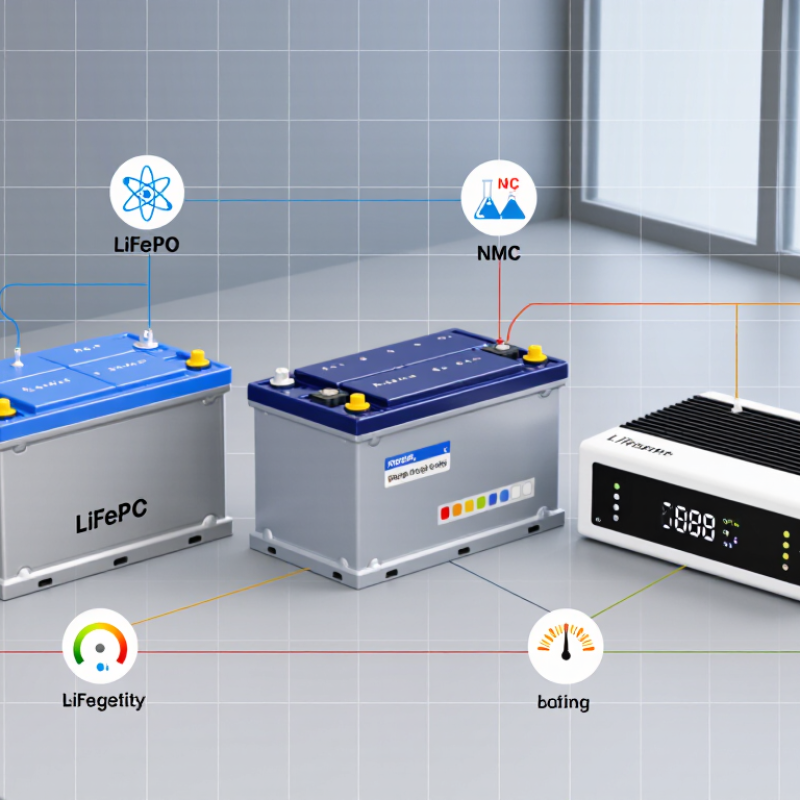
In an RV, lithium chemistry affects weight, usable capacity, charging behavior, and where the battery can be installed. Lithium iron phosphate (LFP) is popular for deep-cycle use because it tolerates frequent cycling and has strong thermal stability. The International Energy Agency reported that LFP supplied about 40% of global electric-car battery demand in 2023. That scale matters: wider production can support availability, though RV packs are not identical to vehicle packs. Nickel-rich chemistries, such as NMC, generally offer more energy per kilogram, which can help when storage space is tight. But a smaller battery is not automatically the better choice.
BloombergNEF’s 2023 battery price survey put the average lithium-ion pack price at $139 per kilowatt-hour, down 14% from 2022. That is useful context, not a direct quote for an RV installation; packaging, controls, and low-volume sales change the final cost. On the road, match chemistry to the inverter load, daily charging window, and cold-weather use. LFP charging near or below freezing needs careful temperature control, and some systems restrict it. Check the battery-management system and usable capacity, not just the label. Not the whole story. Chemistry cannot fix poor wiring, an undersized charger, or a battery mounted where service access is awkward. I would also leave a little capacity margin; real travel days rarely follow the spreadsheet.
Typical cycle life by lithium battery chemistry, measured to approximately 80% of original capacity.
LFP batteries are widely suited to RV power systems because of their long cycle life and strong thermal stability. NMC batteries offer higher energy density, while LTO batteries can deliver very long cycle life but are less energy-dense. Actual performance varies with cell design, temperature, charging, and depth of discharge.
Most lithium RV batteries use lithium iron phosphate (LFP), nickel manganese cobalt (NMC), or, less often, lithium titanate (LTO). LFP offers long cycle life and good thermal stability. Its lower energy density can mean a heavier, bulkier pack. NMC stores more energy in a smaller space, useful when a compartment is tight. However, its performance and service life depend strongly on cell design, temperature, and battery management. Details matter.
LTO systems can tolerate frequent cycling and cold charging better than many LFP designs. They are less common and may cost more. Before buying, compare usable capacity, continuous and surge current, weight, and the battery’s built-in battery management system. Confirm that the charger, solar controller, and alternator charging system match its charging profile. LFP batteries, for example, commonly need charging protection below freezing. A spreadsheet rarely captures cramped access or cold mornings. That detail is easy to overlook.
Capacity starts with voltage and amp-hours, but packaging decides what reaches the campsite. A 12.8-volt, 100-Ah battery stores about 1.28 kWh nominally. Usable energy may be lower. The U.S. Department of Energy’s Alternative Fuels Data Center gives lithium-ion batteries a broad specific-energy range of roughly 100–265 Wh/kg. Chemistry and design create that spread. A finished RV battery also carries an enclosure, wiring, terminals, and a battery-management system. That number can mislead.
Lithium iron phosphate designs often trade some energy density for durability and thermal stability. Other lithium-ion chemistries can store more energy in a given space, but the exact figures depend on cell and pack construction. The awkward trade-off is real: more reserve can mean more weight. A battery’s label alone will not show how much capacity remains available after protective limits.
Installation details matter. Measure the cabinet, cable route, and hold-down space before choosing a pack. Check terminal location and the manufacturer’s charging-temperature limits; cold-weather charging protection may be built in or require careful system matching. Small details matter. A compact pack may fit neatly but leave little room for service access. Compare usable watt-hours, dimensions, and complete-pack weight, not amp-hours alone. I would still verify the figures against the product’s technical sheet; published ranges rarely predict a specific installation perfectly.
Comparison of common lithium iron phosphate (LiFePO₄) battery formats used in recreational vehicles. Figures are representative ranges, not guaranteed specifications; actual dimensions, weight, usable capacity, and installation requirements vary by design.
| Battery Design | Typical Nominal Voltage & Capacity | Nominal Energy | Typical Weight | How Design Affects Capacity and Weight | Installation Considerations | Common RV Applications |
|---|---|---|---|---|---|---|
| Standard 12 V drop-in battery | 12.8 V; commonly 50–100 Ah | 0.64–1.28 kWh | About 6–14 kg (13–31 lb) | A compact, single-battery format offers modest energy storage with substantially less weight than a comparable lead-acid battery. Capacity can be increased by adding compatible batteries. | Often designed for a 12 V battery compartment, but dimensions and terminal positions must be checked. Confirm that the RV’s charger, alternator charging system, and battery monitor support LiFePO₄. | Small and mid-size RVs, camper vans, and basic house-power systems. |
| High-capacity 12 V battery | 12.8 V; commonly 150–300 Ah | 1.92–3.84 kWh | About 18–40 kg (40–88 lb) | More capacity in one battery can reduce wiring and connection points. The larger cell pack makes the unit heavier and may require more compartment space and secure mounting. | Check battery-box dimensions, access for service, cable size, fuse rating, and the battery management system’s continuous current rating. Large units can be difficult to lift into confined spaces. | RVs with higher inverter loads, extended stays, or multiple DC appliances. |
| Slimline or low-profile battery | 12.8 V; commonly 100–200 Ah | 1.28–2.56 kWh | About 10–28 kg (22–62 lb) | A long, shallow enclosure changes the shape rather than the underlying energy density. It can make efficient use of narrow storage areas, while capacity depends mainly on the cell pack inside. | Measure the available length, height, and cable clearance carefully. Confirm mounting orientation and whether the enclosure can be securely restrained during vehicle travel. | Camper vans, under-seat spaces, and RV compartments with limited height. |
| Self-heating 12 V battery | 12.8 V; commonly 50–200 Ah | 0.64–2.56 kWh | About 7–28 kg (15–62 lb) | Integrated heating adds components and can increase weight slightly compared with a similar non-heated model. Heating uses energy from the battery or an external source, so cold-weather operation can reduce energy available to RV loads. | Check the manufacturer’s charging-temperature limits and heating activation conditions. Many LiFePO₄ batteries must not be charged below freezing unless their design safely warms the cells first. | Cold-weather camping or battery compartments exposed to low temperatures. |
| 24 V battery system | 25.6 V; commonly 50–200 Ah | 1.28–5.12 kWh | About 10–55 kg (22–121 lb), depending on capacity | At the same energy, a 24 V system carries less current than a 12 V system, which can reduce cable current requirements. It does not inherently store more energy; watt-hours depend on voltage multiplied by amp-hours. | Requires compatible 24 V loads, charging equipment, inverter, and protection devices. Do not connect batteries of different voltages or mismatched specifications in a bank. | Larger RV electrical systems and installations designed around 24 V equipment. |
| 48 V battery system | 51.2 V; commonly 50–100 Ah | 2.56–5.12 kWh | About 20–55 kg (44–121 lb) | Higher system voltage can deliver a given power at lower current, helping manage cable size and electrical losses in suitable systems. The battery may be heavier and larger because it stores more total energy than a small 12 V unit. | Needs a compatible 48 V inverter, charger, disconnects, fuses, and appropriately rated wiring. Installation and servicing require careful attention to electrical safety and system compatibility. | High-power RV systems with large inverters or substantial energy storage. |
| Modular or rack-style LiFePO₄ battery | Commonly 12.8 V, 25.6 V, or 51.2 V; capacity varies by module | Varies by module and system configuration | Varies widely; larger modules can exceed 30 kg (66 lb) | Capacity is expanded by combining compatible modules. A modular layout supports system growth but adds interconnects, protection requirements, and total installed weight. | Follow the specified series/parallel limits and use matched batteries with compatible battery management systems. Provide suitable ventilation, secure mounting, and access to disconnects and service points. | Custom RV conversions and installations with expandable energy needs. |
Buyer note: Nominal energy is calculated as nominal voltage × amp-hours and is not the same as guaranteed usable energy. Before purchase, compare the exact product datasheet, continuous and peak discharge limits, low-temperature charging protection, dimensions, terminal layout, certifications, and compatibility with the RV’s charging and inverter equipment.
Climate should shape chemistry and battery management. Lithium iron phosphate (LFP) suits many RVs because it offers long cycle life and strong thermal stability, though its pack can be heavier. Nickel-rich lithium-ion packs can save space, but require careful temperature control. In cold weather, check whether the battery management system blocks charging below freezing or includes battery heating. A cold battery may still discharge while refusing to charge. That distinction matters on a frosty morning.
Travel style matters too. A 100 Ah, 12.8 V battery stores about 1.28 kWh nominally. That can support lights, a fan, and device charging, but an inverter and high-draw appliances reduce usable energy. Match capacity to daily loads, then account for cloudy days and driving time. IEA’s Global EV Outlook 2024 reports that LFP reached about 40% of the global electric-car battery market in 2023, up from below 10% in 2020. This is a broad market signal, not an RV performance guarantee.
For humid coastal routes, inspect terminals and enclosure ratings; for dusty roads, secure the pack against vibration. Compare continuous discharge limits with appliances such as a microwave, not just the battery’s amp-hour figure. I would also leave some capacity in reserve. It is easy to plan around perfect weather, and less easy to find a sunny campsite when the forecast changes.
Global buyers should compare certifications, not just voltage labels. IEC 62619 addresses safety requirements for industrial lithium cells and batteries, while UL 1973 covers stationary and auxiliary-power battery applications. Neither label alone proves a battery suits every recreational vehicle installation. Check the certificate’s scope, test edition, and exact battery model. Small details matter.
Charging compatibility depends on chemistry and the vehicle’s equipment. A 12-volt lithium iron phosphate battery may need a different charging profile from a lead-acid battery. Confirm the charger supports the selected chemistry, and disable equalization unless the battery maker expressly permits it. For cold-weather use, check the stated minimum charging temperature; charging lithium cells below freezing can cause damage. A battery management system helps, but it cannot fix an incompatible charger.
Transport and operating safety are different questions. UN Manual of Tests and Criteria, subsection 38.3, sets transport testing requirements for lithium batteries; it is not a substitute for installation guidance. BloombergNEF’s 2024 Battery Price Survey reported an average lithium-ion pack price of $115 per kilowatt-hour in 2024. That market figure does not predict an RV battery’s quality or safety. Ask for the applicable test documentation, installation limits, and clear charging instructions. Paperwork can still be confusing. Check it carefully.
By using this site you agree to the use of cookies by the company in accordance with the Privacy Policy
Have a questions or want to know more about our company? We'll be expecting you.