en
Get in touch

Top 10 Stadium LED Screen Manufacturers for Global Buyers

Choosing a Stadium Led Screen manufacturer is a long-term infrastructure decision, not a simple hardware purchase. Brightness figures matter, but they do not tell the whole story. Buyers should also assess pixel pitch, refresh performance, viewing distance, weather protection, control systems, and maintenance access. During a sunny afternoon match, weak contrast can wash out sponsor graphics. On broadcast cameras, poor refresh behavior may create visible flicker or scanning lines. Small details matter. Access panels, spare modules, and clear calibration procedures can shorten repairs when a screen fails.

This guide to the Top 10 Stadium LED Screen Manufacturers for Global Buyers compares suppliers through practical criteria, including product range, customization, installation experience, warranty terms, and after-sales support. Project references can help, but buyers should check whether those installations resemble their own venue in climate, screen size, and operating demands. A stadium roof, power supply, and viewing distance can change what works best. Drawings do not always show the full challenge. Even a well-specified project can face delays when site conditions differ from expectations.

The right choice depends on more than a low quote or a bold product claim. Ask for measurable specifications, service plans, and examples of comparable work. Confirm who handles commissioning and future repairs. This overview offers a starting point, not a substitute for technical review. Manufacturer capabilities change, and every venue has its own constraints. A careful comparison can help buyers ask sharper questions before committing to a screen built to perform through crowded match days and long seasons.

Top 10 Stadium LED Screen Manufacturers for Global Buyers

Stadium LED Screens: Types, Uses, and Performance Requirements

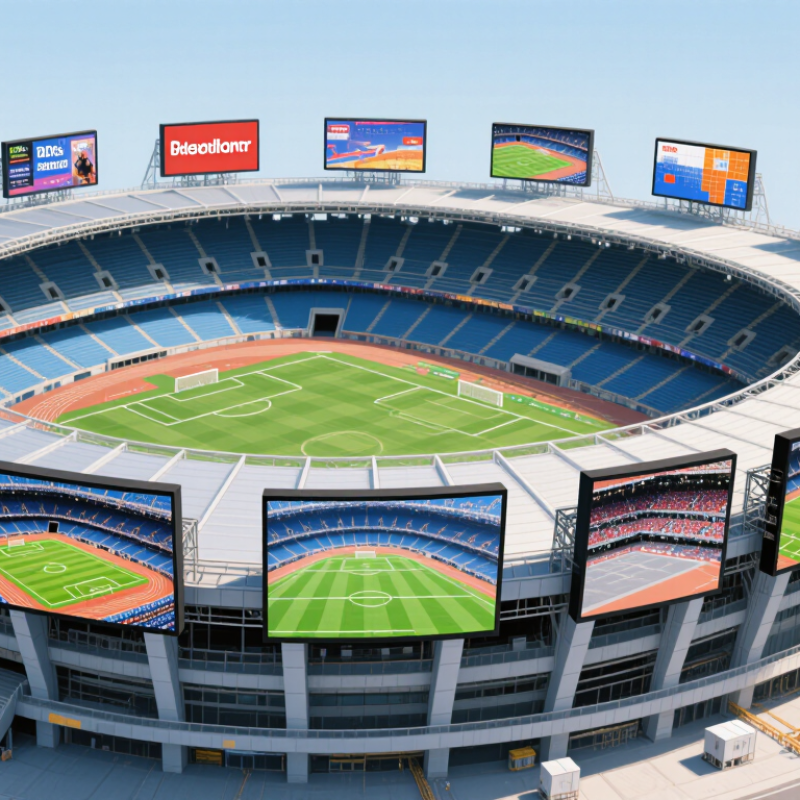
Stadium LED screens serve different roles, and one design rarely suits every venue. Center-hung displays keep scores and replays visible from upper seats, while ribbon boards carry sponsor messages and live statistics around the bowl. Perimeter screens support pitch-side advertising, but need robust protection from impact, dust, and changing weather. Exterior façades can create a landmark, though their viewing distance and structural demands differ from those of indoor displays.

Pixel pitch should match the audience’s distance, not simply be as fine as possible. A tighter pitch can sharpen close-up images, but may raise cost without helping spectators in distant rows. Brightness also needs careful adjustment: sunlight washes out a display, while excessive output at night can distract. High refresh rates and stable processing help reduce flicker on broadcast cameras. Test with real footage. A demo image is not enough.

Performance depends on more than the LED modules. Buyers should check cabinet cooling, weather resistance, spare-part access, and how quickly a failed section can be replaced. Viewing angles matter when seats wrap around the field. So does readable text during fast action. A massive screen can still feel poorly planned if content is crowded or service access is awkward. That trade-off deserves attention before installation.

Stadium LED Screens: Pixel Pitch and Resolution

A finer pixel pitch packs more pixels into the same screen width, supporting clearer images at closer viewing distances. Counts are calculated for a 10 m-wide screen by dividing its width by the pixel pitch; they are illustrative and do not represent a specific product specification.

How Manufacturers Are Evaluated for a Global Top 10

A credible global top ten should compare manufacturers against the same practical criteria, not product brochures. Stadium screens face direct sun, rain, vibration, and long operating hours. Buyers should examine measured brightness, refresh rate, viewing angles, pixel pitch, and color uniformity. Request test reports and sample images captured at realistic viewing distances. Numbers can mislead.

Grand View Research’s 2024 LED Display Market report valued the broader market at USD 7.5 billion in 2023 and projected USD 13.2 billion by 2030. This growth signals a crowded supplier field, but it does not measure stadium-screen quality. A ranking should therefore distinguish stadium installations from indoor retail displays and assess documented project scale, delivery capacity, and component traceability.

Service matters after the opening match. Compare warranty terms, local technician coverage, spare-module availability, and stated repair response times. Ask how suppliers manage color matching when one cabinet is replaced; small mismatches can stand out across a large screen. Check safety and electrical documentation against relevant standards, and verify references through completed projects. Some evaluations still rely too heavily on specifications. Field performance is harder to judge, and even a polished factory demo cannot reproduce a full season of heat, dust, and maintenance pressure.

Profiles of 10 Leading Stadium LED Screen Manufacturers

Profiles of leading stadium LED screen manufacturers differ in engineering focus, not just display size. One specializes in high-brightness outdoor panels that remain legible under afternoon sun. Another emphasizes sealed cabinets and corrosion-resistant hardware for exposed venues. A third designs modular systems, making individual panel replacement faster after impact damage. One supplier focuses on perimeter displays, with refresh rates suited to broadcast cameras. Another builds fine-pitch screens for indoor arenas and premium viewing areas.

Other manufacturers stand out for structural planning, control software, or long-term service. A structural specialist calculates wind loads and mounting stresses before installation. A software-focused maker supports scoreboards, replay feeds, and advertising schedules through one control platform. One company prioritizes lower power use, while another offers curved corners for unusual stadium architecture. A service-led manufacturer keeps spare modules near major installation regions. The tenth profile combines custom engineering with on-site commissioning. These distinctions matter, though published specifications do not always reflect real venue conditions.

Tips: Ask for cabinet weight, brightness measurements, pixel pitch, and service access details. Request references from comparable venues, plus a sample maintenance plan. Check viewing angles from upper seats, not only the pitch. One overlooked point: replacement panels may look slightly different after years outdoors. Verify color matching procedures before signing.

Top 10 Stadium LED Screen Manufacturers for Global Buyers — Profiles of 10 Leading Stadium LED Screen Manufacturers

Anonymized, application-based profiles for comparing stadium LED suppliers. The entries describe real product categories and commonly specified features, not verified specifications for named companies or a ranked list of individual manufacturers.

Profile Typical Stadium Application Common Product Format Pixel-Pitch Considerations Outdoor Protection System and Service Considerations Buyer Verification Points
Profile 01
Perimeter Display Specialist
Pitch-side advertising and continuous perimeter displays Modular outdoor cabinets with protective masks or soft top covers, depending on design Selected according to viewing distance, cabinet height, camera requirements, and budget Outdoor models commonly specify weather protection; confirm the exact front and rear IP ratings Check cabinet access, cable routing, brightness control, and compatibility with the venue’s content system Ask for sightline samples, impact-protection details, spare-module availability, and a written service plan
Profile 02
Scoreboard Display Specialist
Main scoreboards, center-hung displays, and end-zone screens Large-format video boards assembled from serviceable LED cabinets Pitch depends on viewing distance from seating areas and the required text or video detail Indoor and outdoor configurations differ; specify the installation environment before selecting a model Consider controller capacity, redundant signal paths, content workflows, and access for maintenance Verify viewing-angle performance, structural drawings, power demand, and compatibility with scorekeeping systems
Profile 03
Broadcast-Focused Supplier
Displays prominently captured by broadcast cameras Fine-pitch or camera-optimized LED products, selected for the camera and venue setup Choose through camera tests at the intended frame rates, shutter settings, and viewing distances Protection requirements depend on whether the screen is installed indoors, under a roof, or fully outdoors Refresh behavior, grayscale performance, processing, and calibration should be assessed as one system Request recorded camera tests; do not rely on a refresh-rate figure alone to predict broadcast performance
Profile 04
Stadium Ribbon-Board Supplier
Continuous displays around seating decks and fascia areas Long, narrow LED cabinets designed for horizontal installation Pitch and cabinet height should suit the closest seats and the typical viewing angle Indoor concourses and exposed seating-bowl locations require different enclosure specifications Check curved-layout options, cabinet alignment, content zoning, and integration with venue controls Confirm dimensions, mounting tolerances, service access, and visibility from every relevant seating section
Profile 05
Outdoor-Facility Specialist
Open-air stadiums and screens exposed to rain, dust, and temperature changes Outdoor-rated video displays with weather-conscious cabinets and electrical components Set pitch from audience distance and content needs; outdoor ambient light also affects perceived detail Request the rated protection level for the complete installed product, including connectors and service doors Review operating-temperature limits, ventilation or cooling design, brightness management, and drainage Check test reports, local climate suitability, wind-load calculations, and warranty exclusions
Profile 06
Rental and Event-System Supplier
Temporary tournament installations, ceremonies, and event overlays Transportable LED cabinets with rigging or ground-support options Pitch is chosen for event viewing distances, camera positions, and setup constraints Confirm whether the specific rental configuration is suitable for the expected weather exposure Fast assembly, alignment, transport protection, spare parts, and on-site technical support are key Request rigging documentation, setup instructions, connector details, and a realistic replacement-parts plan
Profile 07
Integrated AV-System Supplier
Venues requiring coordinated video boards, ribbon displays, and control-room equipment LED displays supplied with processing, control, and signal-distribution components Different screens may use different pitches to match their individual viewing distances Specify protection separately for each screen location and exposure condition Assess signal formats, latency, redundancy, monitoring, third-party interfaces, and operator workflows Require a complete signal-flow diagram and a demonstrated handover, training, and support process
Profile 08
Custom-Shape Display Supplier
Curved, corner, architectural, or non-standard stadium installations Custom cabinet layouts or flexible display configurations, subject to the product design Pitch, curvature, and viewing angle should be evaluated together with the physical layout Weather ratings must be confirmed for the finished custom assembly, not assumed from individual modules Engineering coordination, structural interfaces, service access, and content mapping are especially important Request project-specific drawings, mock-ups, load calculations, and confirmation of replaceable components
Profile 09
Energy-Conscious Display Supplier
Venues seeking to manage screen power use and operating costs LED video displays with model-dependent power-management and brightness-control features Choose pitch based on required image detail rather than using resolution alone as a buying measure Outdoor suitability remains dependent on enclosure rating, installation, and environmental conditions Compare measured power consumption at defined brightness and content conditions, not only peak ratings Ask for typical and maximum power figures, measurement conditions, and maintenance requirements
Profile 10
Lifecycle-Service Supplier
Major venues prioritizing long-term uptime and maintainability Serviceable cabinet systems with documented replacement and repair procedures Pitch should meet current viewing needs while considering future content and camera requirements Protection and inspection needs should match the venue’s exposure and maintenance schedule Evaluate warranty terms, spare-parts logistics, remote monitoring, technician coverage, and repair training Request service-level terms, parts lead times, escalation contacts, and clear warranty coverage in writing

Comparing Product Ranges, Certifications, and Global Support

Choosing a stadium LED screen manufacturer requires more than comparing headline brightness. Product ranges should cover the actual venue: perimeter boards, large-format displays, control systems, and replacement modules. Check pixel pitch against viewing distance. A screen suited to a close-up concourse may look coarse across a wide seating bowl. Ask for daylight performance data and examples of maintenance access, not just polished renderings.

Certifications deserve careful checking. Request current test reports and confirm that their scope matches the proposed screen, power equipment, and installation market. A logo on a brochure is not enough. Compare warranty terms, environmental ratings, and documented quality processes. Details matter. The paperwork can be tedious, and it may not reveal every issue, but it helps buyers ask better questions before contracts are signed.

Global support is practical, not abstract. Ask where spare modules are stocked, how quickly faults are acknowledged, and whether technicians can support commissioning across time zones. Clarify training, software updates, and escalation contacts in writing. A useful test is to request a sample service plan for a failed cabinet during a busy event week. If answers stay vague, note that risk alongside price; a low bid can become expensive when parts or expertise are far away.

How Buyers Select and Deploy a Stadium LED Screen System

Choosing a stadium LED screen starts with the event, not the pixel pitch. Buyers should map viewing distances, camera positions, sunlight, and likely content before requesting quotations. A screen behind a goal may need different dimensions and protection than a perimeter display. Ask manufacturers for measured brightness, refresh performance, cabinet weight, weather resistance, and service access details. Request test footage or a demonstration with fast motion and fine text. Numbers alone can mislead. Check references for installations facing similar weather, crowd sizes, and operating hours. Confirm spare-parts availability, technician response times, warranty exclusions, and commissioning responsibilities. Clear answers matter.

Deployment planning should cover mounting structures, power capacity, signal routes, and access for maintenance. Have qualified engineers review the site before equipment is ordered. During commissioning, test brightness at different times of day, inspect color consistency, and verify backup signal paths. Train operators using the actual control system and event workflow. A neat specification still leaves gaps. Buyers sometimes underestimate service access; a cabinet that is difficult to reach can turn a small fault into a long interruption. There is rarely a perfect layout, so record unresolved trade-offs and agree on practical remedies before installation.

We value your privacy.

By using this site you agree to the use of cookies by the company in accordance with the Privacy Policy

Have a questions or want to know more about our company? We'll be expecting you.