Top WiFi Humidity Sensors for Global Buyers
Choosing a reliable Wifi Humidity Sensor is rarely as simple as comparing prices or advertised accuracy. Global buyers must examine measurement range, calibration stability, wireless coverage, battery life, app quality, and data protection. A sensor placed beside a kitchen window may behave very differently from one installed inside a warehouse, greenhouse, or museum cabinet. Physical conditions matter.
Kevin Ashton, the IoT pioneer who helped define connected-device thinking, said, “The Internet of Things has the potential to change the world, just as the Internet did. Maybe even more so.” His observation remains relevant because a Wifi Humidity Sensor is valuable only when its readings become useful decisions. A live dashboard, for example, should help prevent condensation near stored electronics, not merely display changing percentages.
This guide evaluates leading options through practical buyer concerns. It considers sensor response time, stated accuracy, Wi-Fi frequency support, cloud dependence, alert functions, installation effort, and long-term maintenance. Compatibility deserves attention. Some devices work smoothly with common smart-home platforms, while others require proprietary applications or complicated integrations.
No shortlist is perfect. Marketing language can hide important limitations. A “high-accuracy” label may not explain temperature conditions, calibration methods, or acceptable error. Readers should question impressive specifications and check independent evidence whenever possible. The best Wifi Humidity Sensor is not always the most expensive model. It is the one that delivers dependable readings, secure connectivity, and clear alerts in the environment where it will actually operate. Small details matter. A weak signal, dead battery, or poorly positioned probe can undermine an otherwise excellent device.
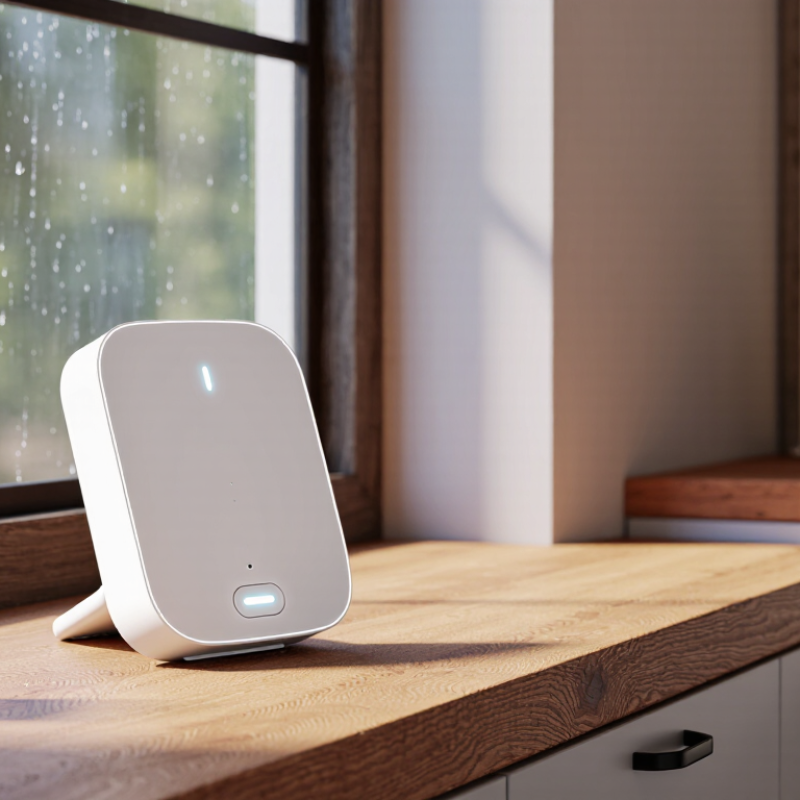
RH Measurement Basics: 0–100% Range and ±2% Accuracy Benchmarks
Top WiFi Humidity Sensors for Global Buyers
Relative humidity, or RH, describes moisture in air compared with its maximum capacity at a specific temperature. A sensor rated from 0–100% RH should cover dry rooms, damp storage areas, and near-saturated conditions. The ±2% accuracy benchmark means a displayed 50% RH value may reasonably measure between 48% and 52% RH. That difference matters when protecting paper, electronics, textiles, or temperature-sensitive materials.
In practical testing, sensor placement often affects results more than the advertised specification. Avoid direct sunlight, air vents, windows, and walls with condensation. Allow the device to stabilize before recording readings. I have seen readings shift after moving a sensor only one meter. Temperature changes can also create apparent humidity errors, especially near cold surfaces. A reliable WiFi sensor should record timestamps, preserve historical data, and reconnect after a temporary network outage. Still, no wireless feature compensates for poor calibration.
Tips: Compare readings with a trusted reference meter during setup. Check performance at low, medium, and high humidity when possible. Do not treat ±2% accuracy as guaranteed across every part of the 0–100% range. Some specifications describe typical performance, not worst-case performance. That distinction deserves attention. Calibration may also drift, and replacement is not always the best first response. Clean installation and periodic verification can reveal whether the sensor, environment, or network is responsible.
Connectivity for Global Buyers: 2.4 GHz Wi-Fi, MQTT, and API Support
For global buyers, a humidity sensor should support 2.4 GHz Wi-Fi, MQTT, and a documented API. The 2.4 GHz band travels farther through walls than higher-frequency bands. It also works with many older gateways and industrial controllers. IoT Analytics reported about 16.7 billion connected IoT devices in 2023. Its 2024 estimate reached 18.8 billion devices. Interoperability is no longer optional.
MQTT enables lightweight, two-way messaging for warehouses, greenhouses, and archive rooms. Choose sensors supporting TLS encryption, configurable publish intervals, and quality-of-service settings.
API access should provide timestamped humidity data, device status, battery levels, and calibration records. An ISO 8573-1 reference is useful when monitoring storage environments, although humidity accuracy still depends on placement and airflow.
A sensor beside a ventilation outlet may report a misleadingly dry room.
Tips: Confirm regional Wi-Fi channels before purchasing. Test pairing through a concrete wall. Request API documentation before deployment. Check whether MQTT credentials can be rotated remotely. In field testing, record readings beside a calibrated reference instrument for several days.
A perfect installation is unlikely. Even strong products can drift after condensation exposure, and many buyers underestimate maintenance. IoT Analytics’ market data supports connected-device growth, but it does not guarantee reliable humidity measurements. Treat connectivity, calibration, and data ownership as separate buying decisions.
Use-Case Ranking: ASHRAE’s 30–60% RH Comfort Band and Alerts
For global buyers, WiFi humidity sensors are most useful when ranked by working conditions, not app features. ASHRAE’s 30–60% relative humidity band offers a practical comfort reference for occupied rooms. It is not a universal rule for every climate, building, or collection. A sensor should show current RH, temperature, and recent trends. Trends reveal a damp corner before the display becomes alarming. Small detail, big value.
Rank one is residential comfort. Place the sensor near breathing height, away from windows, vents, kitchens, and direct sunlight. Set warnings near 30% and 60%, then confirm the alert delay. A brief shower should not trigger a panic notification. Persistent readings deserve attention. Rank two is storage and archives, where stable humidity matters more than comfort. Use tighter internal limits, document calibration dates, and compare readings with a second reference instrument. Wireless signals can fail through concrete walls. Keep a local record.
Rank three is light commercial monitoring, including offices, classrooms, and small retail spaces. Multiple sensors can expose uneven humidity between floors or exterior walls. Buyers should check data security, battery life, operating temperature, and alert history before purchase. Independent calibration testing strengthens confidence, although field conditions remain imperfect. I have seen sensors agree on temperature yet differ noticeably in RH. That uncomfortable gap deserves investigation. Placement, dust, aging, and condensation can distort results. Treat alerts as prompts for inspection, not automatic proof of a building fault.
Global Compliance: CE, FCC, RoHS, and IEC 61000-6-2 Testing
Top WiFi Humidity Sensors for Global Buyers
Global buyers should treat compliance as a design requirement, not a final sticker. CE marking requires documented conformity with applicable European Union rules. It is not a universal safety certificate. FCC requirements address radio-frequency emissions and intentional transmitters in the United States. RoHS limits restricted substances in electrical and electronic equipment. IEC 61000-6-2 testing examines immunity against industrial electromagnetic disturbances, including electrostatic discharge and fast transients. These tests matter when a sensor operates near motors, inverters, or switching equipment.
Industry data shows why this scrutiny is growing. IoT Analytics reported that the global number of connected IoT devices reached 16.6 billion in 2023. More connected devices mean more wireless interference and more procurement checks. MarketsandMarkets also projects strong expansion in the smart sensor market through 2028. Yet market projections are not proof of product quality. Buyers should request recent test reports, declarations, technical files, and clear operating limits. Ask whether testing covered the final enclosure, antenna, power supply, and firmware. Small integration changes can invalidate earlier assumptions.
Tips: Verify the exact model and regional frequency band. Check humidity accuracy across the stated temperature range. Request IEC 61000-6-2 test conditions, not only a passing statement. Keep installation records for audits. One practical concern remains: laboratory compliance may not mirror a crowded factory floor. Pilot testing in the target environment is still wise.
Top WiFi Humidity Sensors for Global Buyers - Global Compliance: CE, FCC, RoHS, and IEC 61000-6-2 Testing
This chart shows the primary compliance frameworks relevant to WiFi humidity sensors sold in the European Union, the United States, and industrial environments. A value of 1 indicates that the framework is relevant to the market or application; 0 indicates that it is not the primary framework. CE covers applicable EU product requirements, FCC applies to radio-frequency devices in the United States, RoHS addresses restricted substances in electrical and electronic equipment, and IEC 61000-6-2 defines EMC immunity requirements for industrial environments.


