By using this site you agree to the use of cookies by the company in accordance with the Privacy Policy
Lighting is no longer judged by brightness alone. Efficiency, thermal control, installation speed, and service life now shape professional LED design.
The International Energy Agency reports that lighting uses roughly 15% of global electricity and creates about 5% of energy-related emissions. That pressure is moving manufacturers toward efficient, modular systems. A reliable Led Harness supports this shift by organizing power, signal, and grounding connections inside compact spaces. It may sit behind a vehicle grille, beneath an architectural ceiling, or inside a humid outdoor sign.
The wiring choice matters.
Common options include single-circuit harnesses, multi-circuit harnesses, RGB and RGBW harnesses, waterproof assemblies, and board-to-board connectors. Each type solves a different practical problem. RGBW designs support color control, while sealed harnesses protect contacts from moisture and vibration. Some systems prioritize low resistance. Others prioritize quick replacement.
Jim Brodrick, former Solid-State Lighting Technology Manager at the U.S. Department of Energy, has emphasized that LED performance depends on the complete system, not only the light source. That idea applies directly to harness selection. A high-efficiency LED can still underperform when its cable is undersized, poorly crimped, or exposed to excessive heat.
This guide compares the top Led Harness types, their construction, applications, and limitations. The categories are useful, but not perfect. Real installations often combine several designs. Connector quality can matter as much as conductor size. Engineers should verify current ratings, insulation temperature, bending limits, ingress protection, and compatibility before production. Data sheets help. Field testing still reveals the uncomfortable details.
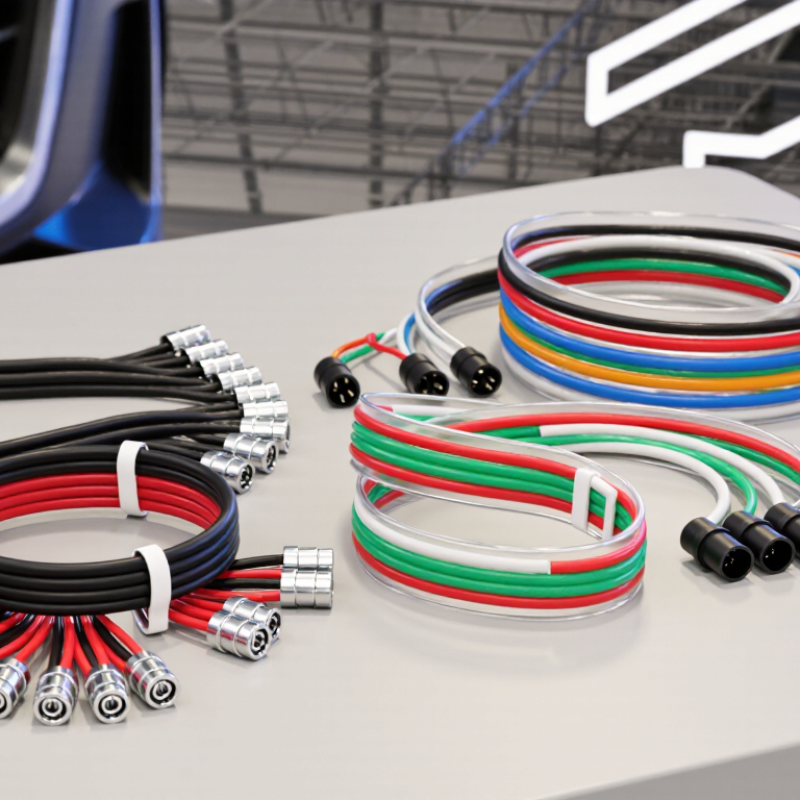
LED harnesses usually fall into four practical types: pigtail leads, splitter harnesses, trunk harnesses, and sealed overmolded assemblies. Each supports a different installation pattern. Pigtails suit single lamps. Splitters serve several low-voltage branches. Trunk harnesses simplify long cabinet runs. Sealed assemblies protect exposed connections.
The U.S. Department of Energy’s 2023 Solid-State Lighting R&D Opportunities report notes that laboratory LED efficacy has exceeded 200 lumens per watt. Better efficacy can reduce current, but poor wiring still creates heat and voltage drop.
Most LED harnesses operate between 5 and 24 VDC. Voltage changes current significantly. A 24-watt load draws 4.8 amps at 5 V, but only 1 amp at 24 V, before losses.
AWG selection should consider current, length, insulation temperature, and allowable voltage drop. A larger conductor is not automatically the best choice. Oversizing adds cost and stiffness. Undersizing creates dim ends and warm insulation.
I have seen short harnesses work perfectly on a bench, then fail after a longer field installation.
IEC 60529 ratings describe enclosure protection, not complete system safety. IP65 means dust-tight protection and resistance to water jets. IP67 generally supports temporary immersion, often up to one metre for 30 minutes under specified conditions.
Connector sealing, cable entry, and assembly quality still matter. A waterproof-looking plug can leak through a poorly crimped terminal. That detail is easy to miss.
Each design should verify the actual load, cable route, bend radius, and environmental exposure.
Two-wire single-color LED harnesses are a practical choice for simple 12 or 24 VDC lighting. One wire carries positive voltage, while the other returns the current. This uncomplicated layout reduces installation time and makes fault tracing easier. It suits cabinet lighting, display shelves, vehicle interiors, and small architectural details.
A single-channel controller adjusts the entire connected load together. It can switch the lights on and off, or provide smooth dimming when the controller supports pulse-width modulation. Confirm the controller’s voltage range and current capacity before connecting anything. For example, a 24 VDC circuit drawing 3 amps needs a controller rated above that load, not exactly at its limit. Leave room for heat and future changes.
Wire length matters more than many installers expect. A long harness can create voltage drop, causing the far end to appear dimmer. Use an appropriate wire gauge, secure every connection, and place suitable overcurrent protection near the power supply. Check polarity with a meter before energizing the circuit. A reverse connection may prevent operation or damage sensitive components.
In field work, I have seen neat-looking harnesses fail because connectors were exposed to moisture. Sealed connectors and protected cable routes improve reliability. Still, no harness is perfect. I once underestimated a cable run and had to replace it with a thicker conductor. That small oversight changed the whole installation schedule. Testing each section before final mounting remains a habit worth keeping.
What Are the Top Types of LED Harnesses?
RGB and RGBW harnesses are common choices for flexible architectural and vehicle lighting. An RGB harness usually uses four conductors: one shared positive wire and three channels for red, green, and blue. An RGBW harness adds a dedicated white channel, requiring five conductors. That extra wire creates cleaner white light and more controlled pastel colors.
Color mixing depends on pulse-width modulation, or PWM. A controller switches each channel on and off rapidly, changing its average brightness. For example, stronger red and lower blue can produce a warm purple tone. Every conductor must match the channel load. I recommend checking current ratings before installation, not after a connector becomes warm.
Small details matter. Use clearly labeled wires, secure crimp terminals, and heat-shrink protection near exposed connections. A multimeter can confirm polarity and continuity before power is applied. Keep cable runs practical, because voltage drop can make distant LEDs appear weaker. This issue is easy to miss. I have seen neat harnesses fail because the shared return wire was too thin.
PWM frequency also affects performance. A low setting may create visible flicker on cameras or during motion. The controller, harness, and LED modules should support the same voltage and channel requirements. Color matching is not always perfect, especially when white LEDs differ in temperature. Testing the completed harness under its real operating load remains the most reliable check.
| Harness Type | Typical Conductors | Channel Arrangement | How Color Is Mixed | Typical Applications | Key Compatibility Check |
|---|---|---|---|---|---|
| RGB harness | 4: one common conductor plus R, G, and B channels | Three color channels; the common conductor may be positive or negative, depending on the system. | A PWM controller varies the red, green, and blue channel outputs to create different colors and brightness levels. | Decorative lighting, accent lighting, and color-changing installations. | Confirm the common-wire polarity, connector pinout, voltage, and controller channel layout. |
| RGBW harness | 5: one common conductor plus R, G, B, and W channels | Four independently controlled channels; the white channel is separate from RGB. | PWM adjusts the RGB channels for color and the dedicated white channel for white-light output or blended effects. | Installations needing both saturated colors and a dedicated white-light mode. | Use a four-channel RGBW controller and verify that the white-channel pin matches the harness and light. |
| RGB extension harness | Usually 4, matching the connected RGB system | Carries the common connection and three RGB channels between compatible components. | Does not create colors itself; it carries the controller’s channel signals and power connections. | Extending the distance between an RGB controller and light sections. | Match conductor count, pin order, connector type, and electrical ratings; account for voltage drop on longer runs. |
| RGBW extension harness | Usually 5, matching the connected RGBW system | Carries the common connection plus four RGBW channels. | Passes separate PWM-controlled RGB and white-channel connections through the extension. | Extending RGBW light runs while retaining independent white-channel control. | Check the five-pin wiring order and extension rating; do not assume RGB and RGBW pinouts are interchangeable. |
Note: Conductor count and color coding can vary by product. Verify the wiring diagram and electrical ratings before connecting a harness. Wire gauge and allowable run length depend on current, conductor material, installation conditions, and acceptable voltage drop.
Addressable LED harnesses connect a controller to individually controlled light pixels. Most use three wires: positive power, ground, and data. Some designs use four wires. The extra conductor may carry clock timing or backup data, depending on the pixel protocol.
A 5 V harness needs careful planning. The data signal is often logic-level, not a separate 5 V power feed. Long runs can lose voltage, making distant pixels dim or unstable. Measure current at full white, not only during a soft color scene. Add power injection when cable length or pixel count requires it. Keep polarity consistent.
Pixel control depends on timing and signal quality. A practical installation uses a compatible controller, suitable wire gauge, and moisture-protected connectors. I have seen a harness appear correct while one reversed connector darkened an entire section. Test before mounting. Still, no wiring plan is perfect. Unexpected voltage drop, electrical noise, or a weak crimp can reveal gaps in the design. Leave access for repairs, because “finished” does not always mean reliable.
Automotive LED harnesses must handle heat, moisture, current, and constant movement. ISO 6722 is a useful reference for automotive cable performance, including insulation behavior and temperature endurance. However, it does not replace every requirement for a complete harness assembly. Connectors, terminals, seals, and fuses need separate evaluation.
Voltage matters in daily operation. A 12 V system usually serves passenger vehicles, while 24 V systems are common in trucks and industrial equipment. The harness must match the circuit voltage and expected load. Undersized conductors can create voltage drop, dim lights, and unwanted heat. Shorter wiring may still need protection. Fuse placement should remain close to the power source.
Vibration resistance is often overlooked. A harness should use secure routing, flexible sections, and strain relief near each connector. Loose wires may rub against metal edges, slowly damaging insulation. Crimp quality also matters more than appearance. A clean terminal can still fail if the conductor is poorly compressed. I would inspect sample assemblies after vibration and temperature testing, not only after visual checks. That approach costs more time. It also reveals weak points that ordinary bench testing may miss. Some designs seem robust at first, yet their seals loosen after repeated movement and thermal cycling.
By using this site you agree to the use of cookies by the company in accordance with the Privacy Policy
Have a questions or want to know more about our company? We'll be expecting you.