en
Get in touch

7 Tips for Choosing a Metal Plate Cutting Machine

Choosing a metal plate cutting machine is a practical decision, not merely a price comparison. The right equipment affects cut quality, production speed, material waste, and workplace safety. A small mistake can become expensive when every plate leaves rough edges or inaccurate dimensions.

This guide shares seven practical tips for evaluating a machine before purchase. It considers cutting technology, plate thickness, working area, accuracy, automation, maintenance, and total operating cost. These factors matter on a busy workshop floor, where steel sheets may arrive warm, dusty, or slightly warped. Watch the details.

My experience with fabrication equipment suggests that specifications alone rarely tell the complete story. A machine rated for thick steel may cut slowly at that thickness. A fast system may also require costly consumables and skilled operators. Buyers should ask for sample cuts using their actual material, thickness, and preferred tolerances. They should also review service response times, training options, spare-part availability, and documented safety features.

Reliable manufacturers explain limitations clearly. They do not promise perfect results for every alloy or production environment. Independent reviews, customer references, and transparent technical documents can reveal performance beyond sales language. Still, no checklist replaces a careful site assessment. Power supply, ventilation, floor space, operator skill, and future workload all deserve attention. Some buyers overlook these conditions. That can be a costly lesson. With a structured evaluation, this metal plate cutting machine guide can help businesses choose equipment that remains dependable beyond the first installation.

7 Tips for Choosing a Metal Plate Cutting Machine

Understanding Your Metal Plate Cutting Requirements

Before choosing a metal plate cutting machine, define the actual cutting requirement, not the advertised maximum thickness. Identify the metal type, plate thickness, sheet size, daily volume, edge tolerance, and expected cut speed. A 6 mm mild-steel plate behaves differently from 6 mm stainless steel. Reflective surfaces, heat distortion, and slag can change the result. Start with the plate. That changes everything.

The World Steel Association reported approximately 1.888 billion tonnes of crude steel production in 2023. This figure shows the scale of the industry, but it does not define your workshop’s workload. A low-volume fabricator may value setup flexibility, while a production line may need stable duty cycles and automatic material handling. ISO 9013:2017 provides thermal-cutting quality classifications, including edge squareness, surface roughness, and dimensional accuracy. Use these criteria when reviewing sample cuts. Ask suppliers for test pieces using your material, thickness, and gas settings. Measure the kerf, bevel angle, heat-affected zone, and hole quality.

Power consumption also deserves attention. The International Energy Agency reported that industry accounted for about 37% of global energy demand in 2022. Efficient operation can therefore affect long-term costs. Still, energy efficiency should not outweigh cut quality or maintenance access. I would recheck production estimates before selecting a high-capacity system. Many buyers overestimate peak demand and underestimate daily changeovers, operator skill, and imperfect material.

Comparing Cutting Technologies for Different Metal Types

7 Tips for Choosing a Metal Plate Cutting Machine

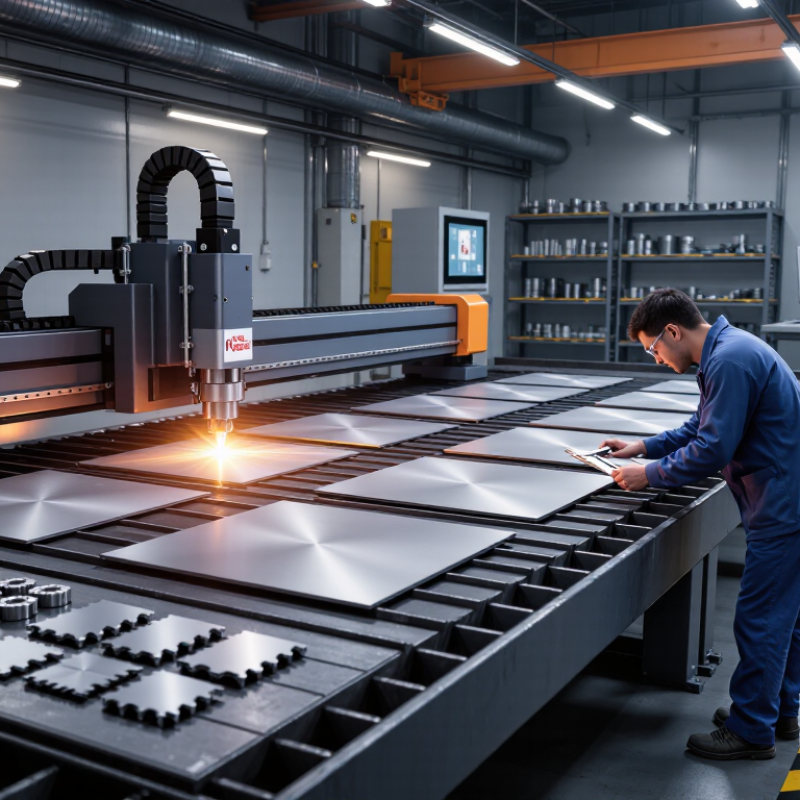
Choosing a plate cutter starts with the metal, not the machine’s advertised speed. Fiber laser cutting suits thin to medium carbon steel, stainless steel, and aluminum. It produces narrow kerfs and clean edges, but reflective metals require careful setup. Plasma cutting handles thicker steel quickly and costs less to operate. Its edges may show more taper and a larger heat-affected zone. Oxy-fuel remains practical for very thick carbon steel, though it is unsuitable for stainless steel and aluminum.

Waterjet cutting works across nearly all metal types. It creates little heat distortion and protects delicate surfaces. However, cutting is slower, and abrasive disposal adds operating work. Check the machine’s real thickness range, not its maximum claim. A supplier should provide sample cuts using your actual alloy and thickness. Inspect the edge, hole quality, warping, and dimensional tolerance under workshop conditions. Small holes often reveal weaknesses before long straight cuts do.

Consider assist-gas consumption, table size, maintenance access, and operator training. A laser may appear efficient, but poor ventilation or unstable gas supply can reduce performance. Plasma may be the better choice for rough structural parts. I once underestimated loading time; the cutter was fast, but production still moved slowly. That mistake changed how I measure productivity. Compare total cost per finished plate, including consumables, power, labor, and scrap. Leave room for future materials. Your current steel order may not define next year’s work.

7 Tips for Choosing a Metal Plate Cutting Machine - Comparing Cutting Technologies for Different Metal Types

The ranges below are typical industrial guidelines. Actual performance depends on material grade, plate condition, machine power, nozzle or lens selection, cutting parameters, tolerances, and part geometry.

Tip Decision Factor Cutting Technology Best-Suited Metal Types Typical Plate Thickness Key Characteristics When to Choose It
1 Match the process to the metal Fiber Laser Carbon steel, stainless steel, aluminum, brass, copper, galvanized steel Approximately 0.5–25 mm, depending on laser power and metal type High cutting speed on thin and medium plate; narrow kerf; good dimensional accuracy; limited heat-affected zone compared with thermal processes Choose for high-volume production, intricate profiles, small holes, and clean edges on electrically conductive metals.
2 Consider heavy-plate capacity Plasma Arc Carbon steel, stainless steel, aluminum, copper alloys Approximately 3–50 mm for common production work; specialized systems can cut thicker plate Faster than oxy-fuel on many medium-thickness conductive metals; moderate kerf width; produces a heat-affected zone and some dross Choose when flexibility across several conductive metals and medium-to-heavy plate productivity are more important than the smallest kerf.
3 Evaluate very thick carbon steel work Oxy-Fuel Low-carbon and mild steel; generally unsuitable for stainless steel and aluminum Approximately 6–300 mm, depending on torch configuration and equipment Low equipment cost; effective for thick mild steel; slower than laser or plasma; wide kerf and a larger heat-affected zone Choose for structural parts, basic profiles, repair work, and thick mild-steel plate where speed and tight tolerances are not the primary requirements.
4 Prioritize a cold cutting process Abrasive Waterjet Carbon steel, stainless steel, aluminum, titanium, copper, tool steel, and heat-sensitive alloys Approximately 1–150 mm; thicker sections are possible at lower cutting speeds Minimal heat-affected zone; no thermal distortion or metallurgical change caused by heat; relatively slow and uses abrasive garnet Choose for heat-sensitive materials, laminated parts, reflective metals, complex contours, or applications requiring minimal thermal distortion.
5 Check tolerance and edge requirements Precision Fiber Laser Thin carbon steel, stainless steel, aluminum, brass, and copper Approximately 0.5–12 mm for high-detail production, depending on power and material Small kerf, strong repeatability, and high detail capability; edge quality decreases as thickness, reflectivity, or heat input increases Choose for parts with small holes, narrow slots, detailed outlines, and reduced secondary machining requirements.
6 Calculate operating and maintenance costs CNC Plasma with Automatic Height Control Carbon steel, stainless steel, and aluminum Approximately 3–40 mm for common production applications Uses consumable electrodes and nozzles; requires fume extraction; operating cost is affected by pierce count, amperage, gas, and consumable life Choose when purchase cost, broad plate capability, and productive medium-thickness cutting outweigh the need for laser-level edge precision.
7 Assess automation, layout, and future needs Multi-Process CNC Cutting System Carbon steel, stainless steel, aluminum, and other conductive alloys, depending on installed processes Ranges from thin sheet to heavy plate according to the selected laser, plasma, oxy-fuel, or waterjet module Combines multiple cutting methods; improves material flexibility but increases integration, programming, ventilation, and maintenance requirements Choose for job shops or manufacturers handling varied metals, thicknesses, batch sizes, and tolerance requirements.

Checking Machine Power, Precision, and Cutting Capacity

7 Tips for Choosing a Metal Plate Cutting Machine

Machine power must match the plate, material, and production rhythm. The 2024 World Steel in Figures report recorded about 1.89 billion tonnes of global crude steel production in 2023. This scale increases demand for reliable plate processing, not simply higher wattage.

Tip 1: Check the rated power against your thickest regular plate.
Tip 2: Compare continuous power, peak power, and duty cycle.
Tip 3: Request test cuts using your actual steel grade.

A bright edge is not enough. Watch dross, heat distortion, and cutting speed.

Precision deserves measurable proof. ISO 9013 evaluates thermal cuts through dimensional tolerance, perpendicularity, and surface roughness. Ask suppliers to state these values for your target thickness.

Tip 4: Inspect repeatability across several cuts, not one sample.
Tip 5: Review positioning accuracy under full-table movement.
Tip 6: Measure finished parts with calibrated tools.

In my experience, a machine can appear accurate during a short demonstration, yet drift after hours of heat buildup. That detail is easy to miss.

Cutting capacity includes more than maximum thickness. It also covers table size, loading method, pierce performance, and software limits.

Tip 7: Choose capacity around your normal workload, with sensible reserve.

Excess capacity can raise energy and maintenance costs. The U.S. Department of Energy’s Better Plants reports consistently emphasize energy measurement as a practical efficiency tool. Still, published figures may not match your workshop. Dust, plate scale, unstable power, and operator habits change results. Leave room for verification.

Evaluating Automation, Safety Features, and Ease of Use

Choosing a metal plate cutting machine starts with the operator’s daily reality. World Robotics 2024 reports that more than 540,000 industrial robots were installed globally in 2023. This growth makes automated loading, nesting, and torch-height control increasingly practical. Look for stable sheet detection, automatic edge finding, and software that records cutting parameters. These functions reduce handling time and improve repeatability. Still, automation is not always better. A complicated interface can slow a trained operator during urgent changes.

Safety features deserve a hands-on review. The U.S. Bureau of Labor Statistics recorded 5,283 fatal work injuries across all industries in 2023. That figure is broad, but it shows why risk controls cannot be treated as accessories. Choose guarded moving areas, emergency stops, door interlocks, fume extraction, and clear fault alarms. Check whether the machine follows principles in ISO 12100 and uses safety-related controls consistent with ISO 13849. Test every stop function physically. Paper compliance is not enough.

Ease of use appears after installation. Can an operator load a 12-millimeter plate without awkward lifting? Are consumable changes visible and tool-free where possible? A useful control panel should show gas pressure, pierce status, alarms, and maintenance intervals clearly. I prefer systems that guide new operators without hiding advanced settings. Training time matters, too. The Manufacturing Institute and Deloitte estimated a potential U.S. manufacturing labor shortage of 3.8 million workers by 2033. That makes intuitive controls valuable. Yet even good automation needs inspection. Sensors can drift. Operators can misread warnings. A short trial with real plates often reveals more than a polished demonstration.

Estimating Total Costs, Maintenance Needs, and Supplier Support

Choosing a metal plate cutting machine starts with the invoice, but the invoice rarely shows the full cost. Estimate purchase price, installation, freight, software, tooling, and operator training before comparing quotations. Ask for a written cost model. A realistic estimate. Power consumption matters when the machine runs several hours each day. Include gas, lenses, nozzles, filters, lubrication, and replacement cutting heads in a twelve-month budget. Track scrap rates too, because unstable cutting can quietly increase material costs. An experienced operator can test sample plates and record cycle time, edge quality, and waste.

Maintenance should be judged by access, frequency, and local technical support. Request a service schedule with daily, weekly, and monthly tasks. Check whether technicians can respond remotely and arrive quickly when production stops. Downtime is expensive. Ask about spare-part availability, diagnostic tools, training, and support after the warranty period. Supplier reliability is shown through clear documentation, realistic lead times, and references from similar workshops. Do not accept vague promises. I have seen buyers focus on cutting speed and underestimate cleaning time, alignment checks, and staff turnover. That mistake can distort the first-year budget. Leave a contingency allowance, even when the quotation looks complete.

7 Tips for Choosing a Metal Plate Cutting Machine

Estimated five-year ownership costs by cutting technology

Use the total cost of ownership—not only the purchase price—when comparing machines. These illustrative planning estimates include equipment acquisition, energy and consumables, routine maintenance, and operator training or supplier support. Actual costs vary with plate thickness, production volume, labor rates, utility prices, and local service coverage.

We value your privacy.

By using this site you agree to the use of cookies by the company in accordance with the Privacy Policy

Have a questions or want to know more about our company? We'll be expecting you.